Introduction
Every great play in lacrosse starts with a pass. Whether you’re an attacker feeding the crease, a midfielder moving the ball up the field, or a defender clearing from behind the cage, passing is the foundation that connects your team. But here’s the thing — most young players don’t practice passing until they’re forced to in a game. And that’s exactly when mistakes happen.
In this post, you’ll learn the Partner Rapid-Fire Passing Drill, why passing breaks down at the youth level, and exactly how to run this drill in your backyard or on any open field to build real game-ready passing skills.
The Problem
Ask any coach — passing consistency is one of the most common issues with youth and beginner lacrosse players. Players tend to practice shooting or wall ball, but skip the dedicated partner passing work that builds the communication between catch and release. The result? Dropped feeds at the crease, errant clears under pressure, and passes thrown too hard, too soft, or just off-target.
The good news is that this isn’t a talent problem — it’s a repetition problem. With the right focused drill, every player at every position can build a reliable, accurate pass.
The Primary Drill: Partner Rapid-Fire Passing Drill
This drill builds catch-and-release quickness, target accuracy, and both-hand passing confidence across all positions.
Problem It Solves
Players struggle with inconsistent passing — especially when fatigued, under pressure, or forced to use their weak hand. This drill addresses the root cause: not enough focused two-handed reps at game-relevant distances.
Purpose & Outcome
Players will develop a faster, more accurate release on both hands, improved cradle-to-pass transitions, and the muscle memory to deliver a clean pass without thinking. These are the exact micro-skills that show up in real game situations for every single position.
Time Commitment
- 15–20 minutes per session, 4–5 days per week
- Works as a warm-up starter or a standalone skill session
- Best results come within 3–4 weeks of consistent practice
Equipment Needed & Setup
- Two lacrosse balls (NOCSAE or SEI certified for game-realistic weight and bounce)
- Optional: a lacrosse rebounder for solo warm-up before partner work begins
- Open space: a backyard, driveway, or field section — you only need about 20 yards of space
- Two players (or one player + a rebounder for solo variation)
Player Position Setup
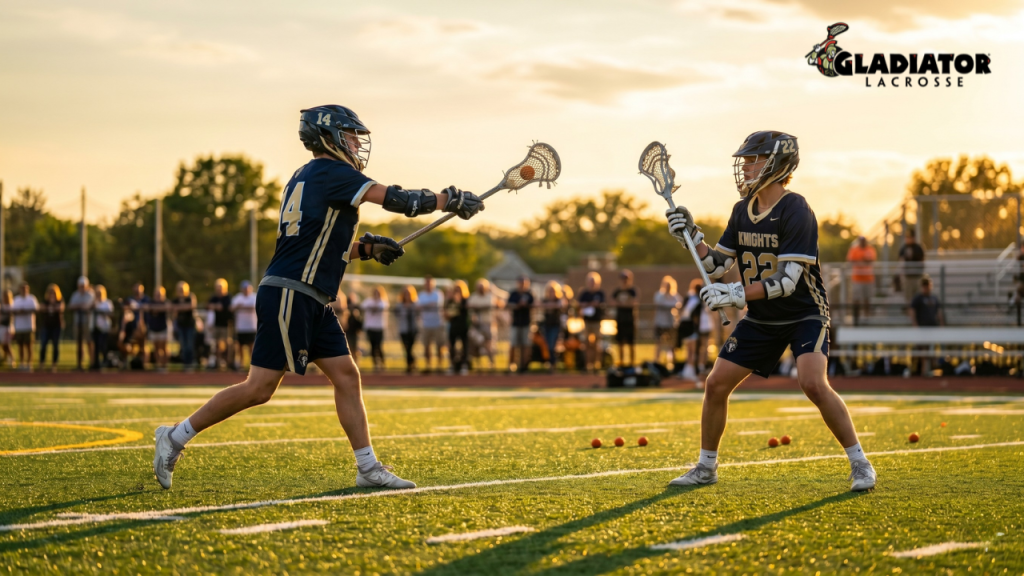
- Partners stand 10–12 steps apart (approximately 10 yards)
- Both players face each other in a balanced athletic stance — feet shoulder-width apart, knees slightly bent, stick up and ready
- Dominant hand players lead with the strong side first, then rotate to weak hand
- Body should be sideways to the target (like a throwing stance) — avoid facing square
Step-By-Step Execution
- Start in ready position — stick up at chest height, feet balanced, eyes on your partner’s stick pocket, not their face.
- Call the catch — as the pass comes in, call “ball!” to build communication habits. Reach for the ball in your pocket, not just your hands.
- Catch with soft hands — cushion the ball into your pocket with a slight give of the wrists. This prevents fumbles and sets you up for a faster release.
- Step toward your target — as you transition from catch to pass, take a short step with your lead foot toward your partner. This transfers weight into the throw and adds power without arm-only effort.
- Pass on the “step” — release the ball as your lead foot hits the ground. The ball should travel chest-to-chest, not high or low.
- Switch hands every 10 passes — alternate deliberately between strong hand and weak hand. Don’t rush through the weak side.
- Increase distance every 3 minutes — start at 10 steps, move to 15, then to 20. This builds range without sacrificing mechanics.
- Finish with game-speed reps — final 2 minutes, both players pass at full game pace, no slowing down, no do-overs.
Key Coaching Points
- Most common mistake: Throwing arm-only — players forget to step, which causes loopy, off-target passes. Cue: “step and snap.”
- Weak hand neglect: Players rush through weak-hand reps. Slow it down and hold proper form until it feels natural.
- Eyes down: Beginners look at the ball too long. Cue: “catch it, then look for the next target.”
- For parents coaching at home: Focus on consistency over power. A clean, accurate 10-yard pass is more valuable than a hard, off-target 20-yard pass.
Performance Targets & Progressions
| Level | Reps Per Session | Goal |
|---|---|---|
| Beginner | 50–80 passes total | Build clean form on both hands |
| Intermediate | 120–160 passes total | Close the gap between strong and weak hand |
| Advanced | 200+ at game speed | Game-speed execution with zero mechanical breakdowns |
Why This Drill Works
The Partner Rapid-Fire Passing Drill works because it trains the full passing sequence — catch, transition, step, release — not just the throw. Most youth players only practice half of it. By adding the step mechanic, the distance progression, and the mandatory weak-hand sets, this drill locks in the muscle memory that carries into real games. Attackers become more reliable feeders. Midfielders become confident outlet options. Defenders clear the ball cleanly and purposefully. It’s one drill that genuinely serves every position.
Product Integration
This drill works even better when you have the right equipment that makes practice easy and consistent. Using NOCSAE or SEI certified lacrosse balls ensures the weight and bounce match exactly what players experience in games — so the habits they build in the backyard carry directly to the field. If a partner isn’t available, a rebounder is a great solo substitute: it returns passes consistently and lets players work through the catch-and-release sequence on their own schedule. Gladiator Lacrosse equipment is built for the kind of everyday backyard practice that turns beginner players into reliable passers — affordable, durable, and easy to set up.
Conclusion
Passing is the most universal skill in lacrosse — and it’s the most under-drilled at the youth level. The Partner Rapid-Fire Passing Drill gives players at every position a structured, repeatable way to build real game-ready accuracy on both hands.
Your three takeaways:
- Step toward your target on every pass — power comes from your legs, not just your arms
- Weak-hand work is non-negotiable; slow it down before you speed it up
- Consistency over distance — a clean short pass beats a sloppy long one every time
Start today: grab a partner (or a rebounder), mark off 10 steps, and run 50 passes — 25 per hand. That’s all it takes to start building the passing foundation every position needs.
About Gladiator Lacrosse
Gladiator Lacrosse was founded in 2012 by Rachel Zietz, a 13-year-old lacrosse player who recognized that high-quality training equipment didn’t have to cost a fortune. After appearing on Shark Tank, Gladiator Lacrosse became one of the most recognized names in youth lacrosse gear. Their lineup includes lacrosse goals, targets, balls, nets, and rebounders — all built to the standard of the game and priced for real families and real programs.
Visit gladiatorlacrosse.com to explore lacrosse goals, targets, balls, and training equipment built to help you improve.