
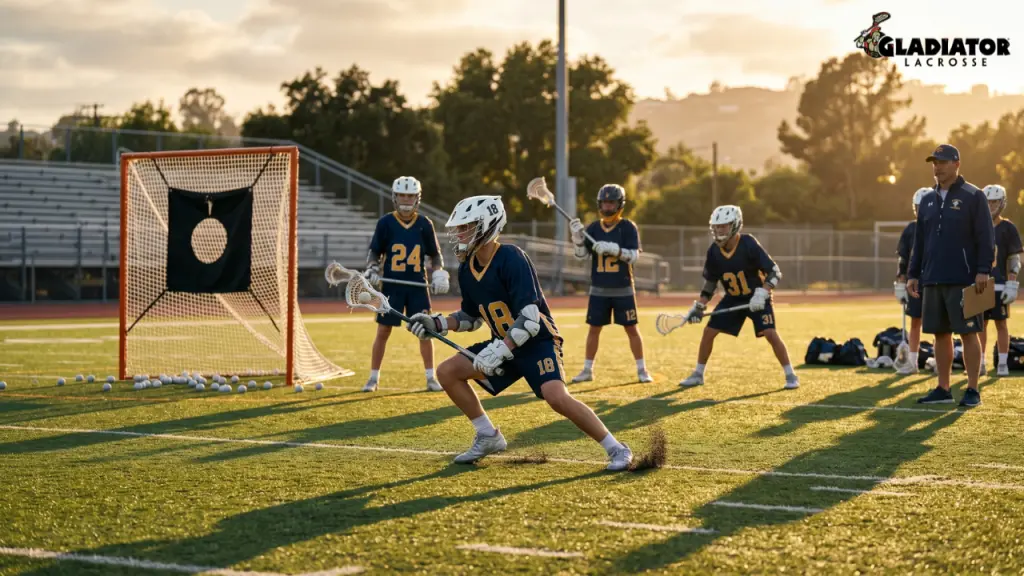
Every lacrosse player knows how it feels to be wide open — and still miss the opportunity. You receive the pass, you have a step on your defender, and the moment falls apart. The shot is late. The defender recovers. The chance is gone.
Most of the time, it’s not your effort that let you down. It’s your attack position.
If you play attack, midfield, or you’re just getting started in lacrosse, learning proper attack position is the single skill that makes everything else — catching, dodging, shooting — work the way it’s supposed to. In this post, you’ll learn the Rock and Roll from X Attack Position Drill, why it works for players at every level, and exactly how to practice it starting today.
Why Attack Position Is So Hard to Get Right
Here’s the challenge most beginners face: attack position isn’t just a stance — it’s a chain of movements that has to happen automatically, at game speed, under pressure.
When your hips are too high, you lose explosion off your first step. When your stick is extended instead of tucked, a defender can strip it clean. When you catch flat-footed, your shot has no power behind it. And because these mistakes happen in fractions of a second, most young players don’t even realize they’re doing it wrong until a coach points it out.
The good news? This is exactly the kind of skill that improves fast with the right drill — because it’s built on repetition, not talent. The players who master attack position aren’t necessarily the most athletic. They’re the ones who practiced the movement pattern enough that it became automatic.
That’s what this drill is designed to do for you.
The Primary Drill — Rock and Roll from X Attack Position
This drill builds the complete attack position sequence — drive from X, protected cradle, inside roll, and finish — that turns passive ball-carriers into confident goal-scoring threats.
Problem It Solves
When players receive a pass or move out from behind the cage (the “X” position), they tend to stand upright, carry their stick exposed, and lose momentum before they can attack the crease or get a shot off. This drill fixes that breakdown by repeating the exact game-situation chain — over and over — until the movement becomes natural.
Purpose & Outcome
Players who work this drill consistently develop a lower, faster, and more protected attack position. That means quicker releases off the catch, better dodge angles when defenders close in, and real confidence driving to the cage from behind or beside the goal. It works equally well for attackers, midfielders, and any beginner learning to handle the ball near the crease.
Time Commitment
- Per session: 15–20 minutes
- Recommended: 4–5 days per week
- Works perfectly as a backyard or driveway solo drill — no team or full field required
Equipment Needed & Setup
- Lacrosse stick (any level)
- Lacrosse balls — NOCSAE certified balls give you game-realistic feel on every catch and finish (product mention 1)
- 2 cones (or water bottles work just as well) — one placed left of the crease at 3 yards off the goal, one placed 5 yards above the goal line extended
- A lacrosse goal or rebounder set up as your finish target (product mention 2)
- Space needed: A backyard, driveway, or open park — roughly 20–30 yards of flat ground is plenty
Player Position Setup
- Start directly behind the goal at the X position
- Feet shoulder-width apart, knees slightly bent — think “ready position” like you’re about to catch something
- Stick held low and close to your body, top hand near the throat of the head
- Weight evenly distributed — not leaning back, not lunging forward
- Eyes up, looking toward your cones or finish target
Step-By-Step Execution
- Start at X with low hips. Set up directly behind the cage. Bend your knees slightly and feel your weight centered. This low, loaded stance is your attack position — the foundation the whole drill is built on. The lower you start, the faster you can move.
- Drive to cone one. Sprint to the first cone placed left of the crease at goal line extended. Make sure your feet are moving before your hands do — footwork first, always. Touch the cone to simulate arriving at a game spot.
- Run behind the crease with your stick protected. As you cross behind the goal, keep your stick tucked close to your body in a loaded cradle. Do not let it float out to the side — this is how defenders strip it clean. Imagine the ball is precious and your arms are protecting it.
- Arrive at cone two loaded. Reach the second cone set 5 yards above goal line extended. Your hips should still be low, your top hand dropped, and your stick in a ready-to-release position. If you feel upright here, reset and go again.
- Execute the inside roll dodge. At cone two, perform an inside roll dodge — pivot your body inward, keep the stick tucked across your body through the rotation, and come out of the roll with your feet driving toward the goal. The stick does not come out until you’re through the roll.
- Catch or finish at the goal. In solo training, time your finish to either catch a return off a rebounder or step into a hard overhand shot at your lacrosse goal (product mention 3). Your weight should be moving toward the goal on the release — not planted or standing still.
- Reset and go again. In line drills, the next player goes right away. Solo? Walk back to X and go again immediately. The goal is 15–20 minutes of near-continuous movement — not long rests between reps.
- Switch sides every set. Once your left-side reps feel solid, mirror the entire drill to the right. Equal reps on both sides builds a balanced, unpredictable attacker that defenders can’t pre-read.
Key Coaching Points
Common mistakes — and how to fix them:
- Hips too high — If you feel slow out of X, your hips are probably too high. Cue yourself: “low start, fast finish.”
- Stick floats out during the roll — Keep the stick tucked all the way through the inside roll, not just at the start of it.
- Stopping at the cone instead of driving through it — The cone is not a checkpoint. It’s a turn signal. Keep your feet moving.
- Flat-footed finish — Your body weight should be moving forward when you release. Shooting from a stopped position costs you both power and accuracy.
Simple cues for young players:
- “Low hips, big drive”
- “Protect the stick like it’s yours”
- “Finish moving, not standing”
What a good rep looks like vs. a bad rep:
- ✅ Good rep: Hips low throughout, stick tucked during the roll, catch-to-release is one fluid motion
- ❌ Bad rep: Upright posture, stick exposed, hesitation or flat-footedness at the finish
Parent coaching tip: If you’re helping a young player at home, watch for the stick position during the inside roll. It’s the most visible mistake and the one that matters most in a game.
Performance Targets & Progressions
| Level | Reps Per Session | Goal |
|---|---|---|
| Beginner | 50–75 | Build the footwork sequence and learn the inside roll shape |
| Intermediate | 100–150 | Add game-speed intent; match strong and weak hand reps |
| Advanced | 200–300+ | Full game-speed execution; inside roll is automatic under pressure |
Why This Drill Works
The Rock and Roll from X is based on a real offensive lacrosse sequence that happens constantly during games — the drive from behind the cage, the crease cut, the protected cradle, and the inside roll finish. By isolating and repeating that exact chain, you train your body to execute it automatically when a defender is pressuring you and there’s no time to think.
For beginners, the biggest benefit is simple: it teaches you where your body is supposed to be before the ball arrives. Most young players react to the ball. Players who’ve drilled this sequence are already in position when it gets there. That half-second difference is what creates goals.
Every position benefits from this drill. Attackers sharpen their most-used tool. Midfielders learn how to handle the ball with confidence near goal. Even defensively-focused players who rotate in on offense build the baseline mechanics that make them dangerous rather than predictable.
How the Right Equipment Makes This Drill Better
This drill works even better when you have equipment that makes practice easy, accessible, and effective — whether you’re on a team field or in your backyard.
A certified lacrosse ball built to game-realistic standards gives you true bounce feedback on every catch, so the reps you take in practice actually translate to how the ball behaves in a real game. A regulation-sized lacrosse goal as your finish target (product mention 4) gives you instant visual feedback on every shot — you either scored or you didn’t, which keeps practice honest and focused.
The best part of this drill is that it doesn’t require a full field or a team. With two cones, a ball, and a goal, you can run it in a backyard or at a local park and get the same quality reps a high school program runs in formal practice.
Start Here — Build Attack Position That Actually Shows Up in Games
Attack position isn’t flashy. It won’t make a highlight reel. But it’s the reason the best young lacrosse players in any program seem to always be in the right spot — and why defenders struggle to stop them even when they guess correctly.
Pick a side and run 50 reps today. Just focus on keeping your hips low and your stick tucked. Don’t add the inside roll yet. Master the drive first, then layer in the roll. Then add the finish. Build it one piece at a time until the whole sequence becomes second nature.
Three things to carry with you:
- Low hips create fast players — your stance is your engine
- A tucked stick is a protected stick — and a protected stick means more possessions
- Reps build automaticity — the goal isn’t to think less; it’s to not have to think at all
About Gladiator Lacrosse
Gladiator Lacrosse was founded in 2012 by Rachel Zietz, a 13-year-old lacrosse player who was frustrated by equipment that didn’t hold up to real practice. After appearing on Shark Tank, Gladiator has grown into one of the most trusted names in lacrosse training equipment — with a simple mission: high-quality lacrosse gear at affordable prices, built by a player for players. From backyard goals to competitive team setups, Gladiator makes equipment that helps players practice more, improve faster, and play with confidence. Visit gladiatorlacrosse.com to explore lacrosse goals, targets, balls, and training equipment built to help you improve.