
Most Players Buy the Wrong Shooting Target First
There’s a predictable arc to buying a shooting target. You get the hardest one available, because you’re not a beginner. You hang it on the goal, take forty shots, hit the little triangle twice, and go back to shooting at the open net where at least something happens.
Lacrosse shooting targets come in three forms and they train different things. A beginner target covers the middle of the goal and leaves the corners wide open, so most well-placed shots still go in. An advanced target covers nearly the whole face and leaves nine small pockets. Corner targets are a separate two-piece set that hangs in the top corners without blocking the goal at all. Start forgiving, then tighten.
That order matters more than which brand you buy, and almost nobody explains it.
How lacrosse shooting targets actually differ
The three types aren’t a good-better-best ladder. They’re three different training tools.
| Beginner Goal Target | Advanced Target | Corner Targets | |
|---|---|---|---|
| What it covers | The centre of the goal | Nearly the entire face | Nothing — mounts in the corners |
| Openings | Seven zones, including large open corners | Nine small pockets | Two separate 18″ x 18″ targets |
| Feedback | Miss the middle and you score | Hit a pocket or you don’t | Hit the square or you don’t |
| Size / weight | 20 x 15 x 4 in, 3.5 lbs | 24 x 14 x 6 in, 6 lbs | 4 lbs for the pair |
| Attaches with | Bungee fasteners plus ground stakes | Bungee fasteners | Bungee fasteners |
| Catches the ball | — | Mesh pockets behind each opening | Rear ball-catching pocket |
| Best for | Learning to place a shot at all | Tightening placement that already exists | Corner-specific reps, and shooting on the run |
Read the “feedback” row again, because that’s the actual difference. A beginner target rewards you for missing the middle. An advanced target only rewards you for hitting a specific small window. Those produce very different practice sessions, and one of them is unusable if your placement isn’t there yet.
Start with the beginner target if you’re honest about where you are
The Gladiator Lacrosse® Beginner Goal Target blocks the middle of the goal and leaves the corners open, which is exactly backwards from what most people expect a target to do.
That’s the point. Young players and players rebuilding a shot default to the middle of the net, because the middle is the biggest part and it’s where the ball goes when you don’t do anything deliberate. In a game, the middle is where the goalie is standing. A target that covers the middle turns “shoot it in” into “shoot it somewhere a goalie isn’t,” and it does that without demanding pinpoint accuracy on day one.
It’s also the lightest of the three at 3.5 pounds, and it’s the only one that ships with ground stakes as well as bungee fasteners, which matters if your goal sits on grass and the wind moves things around.
Use it until you’re hitting corners on most shots with both hands. Then move up.
When to move up to the advanced target
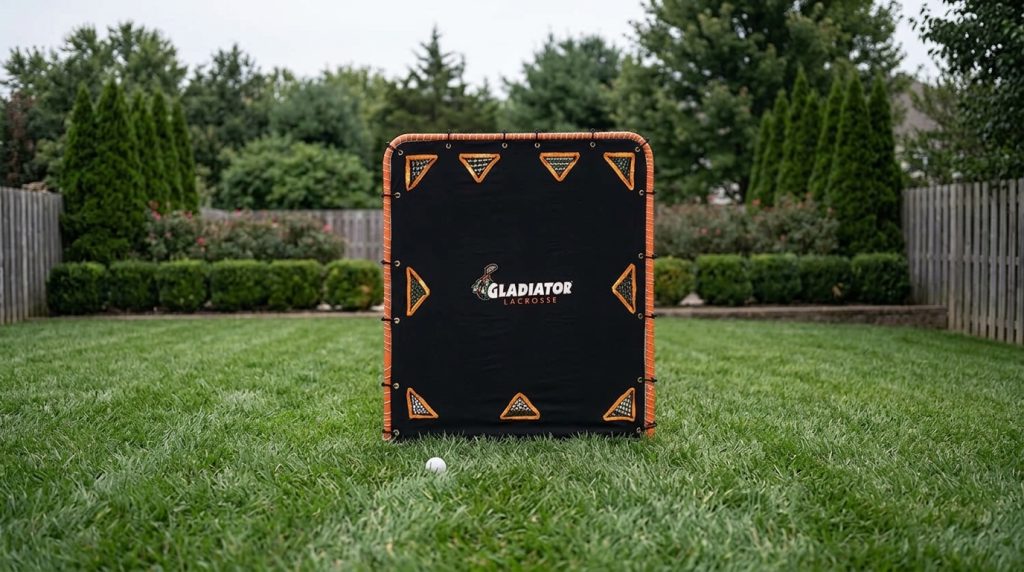
The Gladiator Lacrosse® Advanced Target is a genuinely different demand. It covers almost the whole goal face and leaves nine small pockets — four across the top, one on each side at mid-height, and three along the bottom. Each opening has a mesh pocket behind it, so a hit catches the ball instead of sending it into the neighbour’s yard.
Two things make it worth the step up once you’re ready. Nine scattered pockets mean you can call a spot before you shoot, which is how placement actually gets trained: not “hit a corner” but “hit that one.” And the ball-catching pockets cut your retrieval time enough that a session stops being half walking.
The honest caveat is the one at the top of this post. If you can’t reliably hit a corner yet, nine small windows won’t teach you to — it’ll just lower your hit rate until you stop enjoying practice. The product page describes it for intermediate and advanced players, and that’s accurate rather than marketing.
At 6 pounds it’s the heaviest of the three, and it’s stated as weatherproof, which is the relevant spec for something living on a backyard goal.
Corner targets do something the other two don’t
The Gladiator Lacrosse® Corner Targets come as a set of two 18-inch squares that mount in the goal’s corners with bungee fasteners. Each has a rear pocket that catches the ball.
Here’s why they’re not just a smaller version of the other two: they don’t cover the goal. The net stays open. So you can run a normal shooting drill, or shoot on the run, or have a goalie in there, and still get specific feedback on whether you hit the corner. The other two targets change what the goal is. Corner targets add information without changing the drill.
That makes them the most useful of the three for a player who already practices with a partner or a team, and the least useful for a kid alone in a yard who needs the target to also stop the ball.
How to train with lacrosse shooting targets without wasting reps
A target on a goal doesn’t automatically make practice better. A few things that decide whether it does:
Call the spot out loud before you shoot. The whole value of a multi-pocket target is choosing. Shooting at “the target” generally and hoping something lands is just shooting.
Alternate hands every set, not every session. The off hand is where accuracy is actually missing, and it’s the first thing to get skipped when you’re tracking hits.
Shoot from one spot until it’s boring, then move. Placement is spot-specific at first. Hitting the top-left from the right wing is a different skill than hitting it from up top.
Count misses, not just hits. A session where you hit six of forty is data. A session where you “worked on shooting” isn’t.
Stop before the form goes. Accuracy work degrades fast once you’re tired, and tired reps teach the wrong motion. This is different from conditioning work, where fatigue is the point.
If you want drill structure to hang this on, Gladiator’s shooting accuracy drills pair with any of the three targets.
What a target won’t fix
Worth saying plainly, because targets get sold as a solution to everything.
A target trains placement. It doesn’t train shot power, it doesn’t fix a broken throwing motion, and it won’t help a player whose hands aren’t developed enough to put the ball where they intend. If the ball is going roughly where you aim and you want it going exactly there, a target is the right purchase. If the ball isn’t going roughly where you aim, the problem is upstream and wall ball is the better use of the same hour.
One practical note: every one of these targets is sized for a regulation 6′ x 6′ goal, and the goal isn’t included with any of them. If you’re not sure what you’ve got, the goal sizing guide covers regulation dimensions and the youth sizes that differ.
Bottom line
Buy the beginner target if a player still shoots at the middle of the net. Buy the advanced target once they’re hitting corners and need to hit specific corners. Buy corner targets if they already train with a partner or a goalie and just want the feedback. The most common mistake is buying the hardest one first, and the cost of that mistake isn’t the money — it’s a kid who stops practising because nothing they do works.
A Word on Gladiator Lacrosse
Gladiator Lacrosse was founded in 2012 by Rachel Zietz, then a 13-year-old player in Boca Raton who couldn’t find backyard equipment that survived being used. The catalogue is lacrosse-only: official-size steel-framed goals, replacement nets in four twine thicknesses, NOCSAE-standard SEI-certified balls, rebounders, and shooting targets.
All three targets in this post attach to a standard 6′ x 6′ goal with bungee fasteners and are sold separately from the goal. The Beginner Goal Target blocks the centre and leaves the corners open with seven zones. The Advanced Target leaves nine mesh-backed pockets. The Corner Targets are a two-piece set that adds corner feedback without covering the net. You can see all of them on the targets page.
You Might Also Like
- Shooting targets — all three types with full specs
- What size lacrosse goal you need — regulation dimensions, and where youth sizes differ
- Shooting accuracy drills — structure to run your target sessions on
FAQ
What are the different types of lacrosse shooting targets? Three. A beginner target covers the centre of the goal and leaves the corners open, so placement is rewarded without demanding precision. An advanced target covers nearly the whole face and leaves a set of small mesh-backed pockets. Corner targets are separate squares that mount in the corners and don’t cover the goal at all.
Which lacrosse shooting target should a beginner get? The beginner-style target that blocks the middle. New players naturally shoot at the centre of the net, which is where a goalie stands, and a centre-blocking target retrains that without requiring pinpoint accuracy. A nine-pocket advanced target is counterproductive at this stage because the hit rate is too low to stay motivating.
Do lacrosse shooting targets fit any goal? These are sized for a regulation 6′ x 6′ goal, which is the standard size in both the men’s and women’s games. The goal is not included with any target. Youth programs sometimes use smaller goals at the youngest age levels, so check your goal’s size before ordering.
How do lacrosse shooting targets attach to the goal? With bungee fasteners that loop through grommets around the target’s perimeter and around the goal frame. The Gladiator Beginner Goal Target also ships with ground stakes, which help on grass and in wind. Attachment takes a few minutes and the targets come off just as easily for storage.
Do shooting targets catch the ball? The advanced target has a mesh pocket behind each of its nine openings, and the corner targets have a rear ball-catching pocket, so a successful shot is held rather than lost. That matters more than it sounds: retrieval time is what turns a 30-minute session into 10 minutes of actual shooting.