
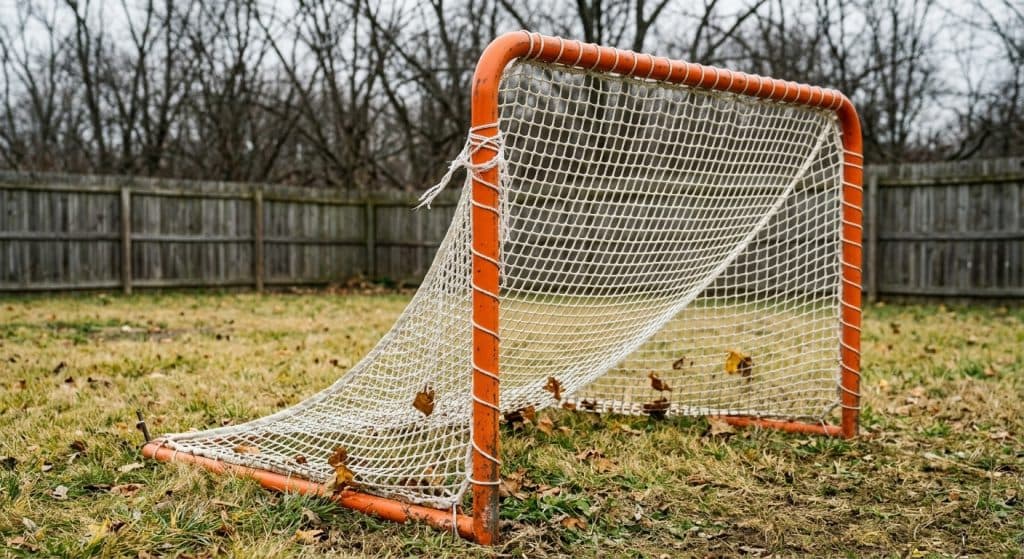
What Actually Kills a Backyard Lacrosse Goal
It isn’t shooting. A steel goal absorbs a remarkable number of shots without complaint. What finishes backyard goals is much duller than that: standing water at the feet, a full winter under snow, and nobody ever looking at the thing between March and March.
Lacrosse goal maintenance comes down to two inspections a year and one decision about winter. Check the frame hardware, the net’s attachment points, and the corners and bottom edge of the net at the start and end of every season. Over the off-season, fold or disassemble the goal and store it under cover if you can. If you can’t, get the feet out of standing water and expect the net to age faster than the frame.
That’s the whole routine. Here’s what each part actually means, and what happens if you skip it.
Why the net fails before the frame
Worth understanding, because it changes where you spend money.
The frame is painted steel. Rain and sun are largely fine for it. What harms a frame is water sitting at the base for months, and hardware that works loose and never gets checked.
The net is the wear item, and it fails from three directions at once. Sun breaks down the twine, which is the chalky, brittle feel an old net develops. Ground balls hammer the bottom edge, which takes more abuse than any other part. And tension stresses the corners continuously, whether anyone is shooting or not.
Which is why replacing a net is routine and replacing a frame usually isn’t. If you budget for one thing on a goal, budget for netting.
Twine thickness is the lever you have on that. The heavier nets in Gladiator’s replacement range — the 6.0 mm and 7.0 mm options — are the ones that state a UV and weather-resistant finish, and that’s not stated on the 5.0 mm tier. If your goal lives outside through real summers, that’s the single most relevant line on the spec sheet. The net thickness guide covers the full range if you’re choosing.
The lacrosse goal maintenance routine, twice a year
Ten minutes at each end of the season catches nearly everything.
Start of season:
| Check | What you’re looking for | If it’s bad |
|---|---|---|
| Frame hardware | Loose snap connections, bolts backed out, anything that rattles | Tighten before first use, not after |
| Frame base and feet | Rust bloom, pitting, standing-water damage | Move where the goal sits; treat surface rust early |
| Net attachment | Cord gone stiff, frayed or snapped; bungees that have lost tension | Re-lace or swap fasteners |
| Net corners | Gaps a ball could pass | Add passes through the corners |
| Net bottom edge | Fraying, thin spots, holes | This is where nets die — assess honestly |
| Ground anchors | Pulled out, missing, loose in soft ground | Re-stake with more points than you think you need |
End of season: the same list, plus the storage decision below. Doing it at the end is what stops you discovering a dead net the week the season starts.
Between times, the only ongoing task worth doing is rinsing mud and grass off the net after it gets filthy and letting it dry. Not for appearance. Caked grit abrades twine from the inside.
Can you leave a lacrosse goal outside over winter
You can. It’s steel and it’s built for outdoor use. The honest answer is that it costs you net life, and how much depends on your winter.
If you can store it, store it. Gladiator’s backyard goals use snap-together assembly and come apart for storage, which is the whole point of that design. Break it down, coil the net loosely rather than crushing it into a ball, and put both somewhere dry. That single habit does more for a goal’s lifespan than everything else on this page combined.
If you can’t store it, do these three things. Get the feet out of any spot that puddles or holds snowmelt. Even shifting the goal a few feet matters. Take the net off and store just the net, if nothing else; the net is the part winter actually ruins and it’s the easy half to carry inside. And clear heavy snow load off rather than letting it sit, because wet snow is heavier than it looks and it stresses attachment points for months.
One thing worth knowing before you decide: Gladiator’s stated warranty covers manufacturing defects for 90 days and explicitly excludes normal wear and tear and improper care. So year-two weather damage is your problem regardless, which is an argument for the ten-minute inspections rather than against them. The warranty page has the actual terms.
When to replace instead of repair
There’s no published lifespan for a lacrosse net, and any guide that gives you one in seasons is guessing. At least one goal manufacturer declines to name a timeframe and points to visible damage instead. That’s the right approach, so judge by condition:
Repair when the problem is attachment rather than fabric — snapped cord, failed bungees, a corner that’s gapped, a small hole away from a stress point. New lacing cord or a bundle of bungee fasteners fixes most of these in an afternoon, and re-fitting a net is a known job. The lacing guide walks the sequence.
Replace when the twine itself has gone. The tell is feel rather than sight: brittle, chalky, or stiff twine has UV damage throughout, which means it won’t fail in one place, it’ll fail in five places over one season. A net with holes a ball can pass through is also done. That’s a scoring dispute in a backyard game and an actual rules problem in the women’s game, where no gap may be large enough to pass a ball.
Frames rarely need replacing. Surface rust is cosmetic and treatable. Bent tubing or a failed weld is different, and at that point you’re pricing a frame against a goal.
The five-minute version
If you do nothing else on this list:
- Take the net off and store it over winter, even if the frame stays out.
- Keep the feet out of standing water.
- Check hardware and net corners once before the season starts.
- Replace cord when it’s stiff, not when it snaps.
- Judge the net by how the twine feels, not how old it is.
Bottom line
Lacrosse goal maintenance is two inspections and one storage decision, not an ongoing chore. Frames outlast nets by years, so the net is where the attention and the budget belong. Store it over winter if you possibly can, keep the base out of water if you can’t, and replace netting on how the twine feels rather than on a calendar. And know going in that the warranty covers manufacturing faults rather than weather, which makes the ten minutes worth spending.
A Word on Gladiator Lacrosse
Gladiator Lacrosse exists because of exactly this problem. Rachel Zietz founded the company in 2012, at 13, because the backyard goals and rebounders she could buy as a player either cost too much or fell apart from being left outside. Surviving real use was the original design brief.
That’s why the parts that wear out are sold separately rather than forcing a whole replacement. The replacement net range spans 5.0 mm through 7.0 mm in round, square and universal corner styles, with the 6.0 mm and above stating a UV and weather-resistant finish. Goal lacing cord and bungee fasteners are stocked as separate items, and the backyard goals snap apart for off-season storage.
You Might Also Like
- Replacement nets — thicknesses, corner styles and which state a UV finish
- How to lace a lacrosse net — the re-fitting job, step by step
- Warranty information — what’s actually covered, and for how long
FAQ
Can you leave a lacrosse goal outside in the winter? You can, since the frame is steel and built for outdoor use, but it shortens net life. The better approach is to break the goal down and store it, or at minimum take the net off and store just the net, since the net is the part winter actually ruins. If the goal stays out, keep the feet clear of standing water and clear heavy snow rather than letting it sit.
How often should you do lacrosse goal maintenance? Twice a year is enough for a backyard goal: a ten-minute inspection at the start and end of each season. Check frame hardware, net attachment points, the net’s corners and bottom edge, and the ground anchors. Between inspections, rinse mud and grass off the net when it gets filthy, since caked grit abrades twine.
How long does a lacrosse net last? No manufacturer or governing body publishes a lifespan, and any specific number of seasons you see is guesswork. Judge by condition instead. Twine that feels brittle, chalky or stiff has UV damage throughout and will start failing in several places at once. Holes large enough to pass a ball mean the net is finished regardless of age.
What’s the most common cause of lacrosse goal damage? Water and neglect rather than shooting. Standing water at the base of the frame, a full winter under snow load, and hardware that works loose and never gets checked do more damage than shots do. On the net specifically, sun degrades the twine, ground balls wear out the bottom edge, and constant tension stresses the corners.
Should you repair or replace a lacrosse net? Repair when the failure is in the attachment — snapped cord, failed bungees, a gapped corner, a small hole away from a stress point. Replace when the twine itself has gone brittle or chalky, because UV damage is throughout the net rather than in one spot, so patching buys very little time.