
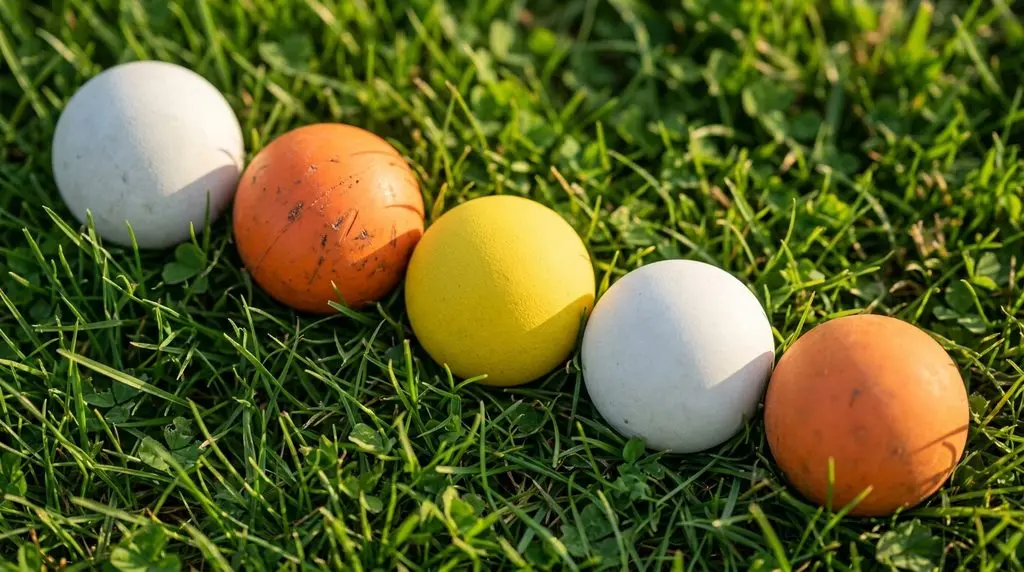
Yellow, White, Orange, Pink: Somebody Actually Wrote Rules About This
A parent buys a six-pack of lacrosse balls in whatever color was on the shelf, hands them over, and finds out at the first game that the officials won’t use them. It’s a small, avoidable annoyance, and it happens because lacrosse ball colors are governed by the rulebook rather than by taste.
Here’s the short version. NCAA men’s rules allow white, yellow, orange, lime green or pink. NCAA women’s rules are much narrower: the ball must be yellow or bright orange, with yellow as the default if the two teams can’t agree and yellow required for NCAA tournament games. So yellow is the only color that is legal everywhere, in both games, at every level.
That single sentence solves the problem for most families. The rest of this is the detail behind it, including a change that’s about to make white balls a lot less common in the men’s game.
What the men’s rulebook allows
NCAA men’s Rule 1-16 states that the ball shall be white, yellow, orange, lime green or pink, made of smooth or slightly textured solid rubber, and must meet the current NOCSAE lacrosse ball standard. If the two coaches disagree about which ball to use, a white smooth ball is used.
Five legal colors is generous, and it’s why you’ll see practice bags full of orange and pink balls at men’s and boys’ programs. The color is a visibility and preference decision, not a compliance one — as long as it’s on the list and the ball is certified.
That last part matters more than the color does. Color legality is trivial next to certification, which is the thing that actually gets a ball rejected, and it’s worth understanding what the NOCSAE mark on a ball means before you worry about the shade.
What the women’s rulebook allows
The women’s game is stricter, and this catches people out constantly.
The NCAA women’s rulebook specifies that the ball shall be yellow or bright orange and made of solid rubber, that it shall meet the current NOCSAE standard, and that all balls shall specify that they meet that standard. The home team supplies the game balls, the two teams agree on yellow or bright orange before game time, yellow is the default if no agreement is reached, and a yellow ball is used for all NCAA tournament games.
Two colors. Not five. A white ball is not a legal women’s game ball, and neither is a pink one, whatever the men’s rulebook says.
USA Lacrosse’s girls’ youth rules run slightly wider — yellow, lime green or bright orange — but the principle holds all the way down: the girls’ game is a short list and yellow is always on it.
The comparison table
| Level | Legal ball colors | Practical default |
|---|---|---|
| NCAA men’s | White, yellow, orange, lime green, pink | White today, moving to fluorescent green or yellow |
| NCAA women’s | Yellow or bright orange only | Yellow — and required in tournament play |
| USA Lacrosse girls’ youth | Yellow, lime green or bright orange | Yellow |
| Boys’ youth / practice | Any legal men’s color | Whatever’s in the bag |
Note what the table makes obvious: yellow is the only color that appears in every row. If you buy one color and you want it to be usable by anyone in your house at any level, buy yellow. A six-pack or box of yellow balls is the lowest-regret purchase in the entire catalog for exactly this reason.
The change coming to the men’s game
This is the part worth knowing if you’re buying now.
The NCAA is recommending for 2026-27 and mandating for 2027-28 that standard game balls for men’s lacrosse be fluorescent green or yellow, to improve visibility. The Premier Lacrosse League already uses an optic yellow ball optimized for television, following a trend that started with tennis in the 1970s, and women’s lacrosse has been played with a yellow ball since the advent of the modern college game.
So the traditional white men’s ball is on a clock at the college level. High school and youth rules don’t automatically follow NCAA changes, and nobody should throw out a bag of white balls over this. But if you’re a college-bound player who wants to train with what you’ll compete with, yellow is now clearly the forward-looking choice rather than just the safe one.
There’s also a practical argument that has nothing to do with rules: a yellow or fluorescent ball is genuinely easier to track against grass, against a dark rebound surface, and in the last hour of daylight. Anyone who has lost a white ball in a white-sky November evening already knows this.
Does the color change the ball?
No. Color doesn’t affect weight, circumference, bounce or how the ball plays. Every certified ball, in every legal color, is tested against the same NOCSAE performance standard — the standard covers weight, circumference, compression deflection load and coefficient of restitution, and says nothing about pigment.
What color can signal is intent. Programs often run one color for games and another for practice, purely so nobody walks off with the good ones. That’s a stock-control decision, and it’s a sensible one.
What to actually buy
If you play or coach in the girls’ or women’s game: yellow. It’s legal everywhere, it’s the tournament default, and it removes the entire question.
If you’re a boys’ or men’s player: yellow if you want one bag that works for everything, white if your program still runs white game balls, and anything on the list for wall ball and backyard work.
If you’re buying for a program: buy your game balls and your practice balls in different colors and keep them separated. Then buy more practice balls than you think you need — the single biggest determinant of how much work gets done in a session is how long players spend walking to retrieve.
If you’re buying for a young beginner: color matters less than softness. A soft training ball is a legitimate starting point before a standard rubber ball, and USA Lacrosse’s own youth guidance recommends a soft ball or similar-diameter alternative at the youngest brackets.
For anything beyond the backyard, though, buy certified. Color legality is easy to fix. A bag of uncertified balls that can’t be used in a game is money gone.
Bottom line
Yellow is legal in every rule set, at every level, in both games — and the NCAA men’s game is now moving toward fluorescent green or yellow anyway. White remains legal in men’s play for now and is not legal in the women’s game at all. Orange works in both, pink and lime green only on the men’s side. If you want one answer and no further thought: buy yellow, and make sure it says it meets the NOCSAE standard on the ball itself.
A Word on Gladiator Lacrosse
Gladiator Lacrosse was founded in 2012 by Rachel Zietz, a 13-year-old player in Boca Raton who couldn’t find backyard gear that survived being left outside. Balls were one of the first things she got right, and they’re still the part of the catalog that gets used every single day.
The lacrosse balls are 100% vulcanized rubber, meet NOCSAE standards and carry SEI certification, and come in singles, packs of three and six, boxes of twelve and cases of 120 — so a family buying six and a program buying 120 are buying the same ball. Yellow runs through every size, which, per everything above, is the one that works everywhere. There’s also a ball bag, which sounds like a trivial purchase right up until the first time you carry 120 balls without one.
You Might Also Like
- What the NOCSAE mark actually means — the certification that matters more than color
- How many reps a wall ball session should be — where most of your balls will get used
- Working out what size goal you need — the other spec people get wrong
FAQ
What color lacrosse ball is legal in every level of play? Yellow. NCAA men’s rules allow white, yellow, orange, lime green and pink; NCAA women’s rules allow only yellow or bright orange; USA Lacrosse girls’ youth rules allow yellow, lime green or bright orange. Yellow is the only color that appears in all three, which makes it the safest single purchase.
Can girls use a white lacrosse ball in a game? No. The NCAA women’s rulebook specifies yellow or bright orange, and girls’ youth rules allow yellow, lime green or bright orange. A white ball is fine for practice and wall ball but is not a legal women’s or girls’ game ball.
Is the NCAA changing the men’s lacrosse ball color? Yes. According to USA Lacrosse, the NCAA is recommending fluorescent green or yellow game balls for 2026-27 and mandating them for 2027-28, with improved visibility as the reason. High school and youth rule sets don’t change automatically, so check your own governing body.
Does lacrosse ball color affect performance? No. Color has no bearing on weight, circumference, bounce or feel. Every certified ball is tested against the same NOCSAE performance standard regardless of color. Brighter colors are easier to track visually in low light, which is a practical benefit rather than a performance one.
Why do teams use different colored balls for practice and games? Mostly inventory control. Keeping game balls a different color from practice balls stops the good ones disappearing into practice bags, and makes it obvious at a glance which pile is which at the end of a session.