
Nothing in the Rules Slows Down for a Late Starter
A thirteen-year-old walking into their first lacrosse practice is standing next to kids who have been playing since they were six. Same drills, same expectations, same stick specification, same ball. Seven years of touches on one side and none on the other, and the session doesn’t acknowledge the difference.
That’s the actual problem with starting lacrosse late, and it’s worth naming precisely because it’s more fixable than it feels. The gap isn’t athleticism and it usually isn’t understanding the game. It’s touches. The raw number of times a ball has been caught and thrown. Nothing about the rules or the age groups adjusts for that, so the only lever a late starter has is volume, and volume is something you can add outside of practice.
That’s genuinely good news, because it’s the one kind of deficit you can close on your own schedule.
What a late starter is actually behind on
Being specific helps, because “behind” feels much bigger than it is.
Hands. Catching and throwing, with both hands, without thinking about it. This is the whole gap, or near enough. A player who started at six has caught a ball tens of thousands of times. That’s not talent, it’s arithmetic.
Stick comfort under pressure. Related but distinct. Catching in a quiet drill is one thing; catching with someone closing on you is another, and the second one only comes from the first being automatic.
Nothing else, really. Game understanding comes fast, especially for an older player who’s played other field sports. Conditioning is sport-agnostic. Positional knowledge is learnable in a season. An older beginner often arrives with better athleticism, better coachability and a longer attention span than the kids who started young.
So the honest framing: you’re not behind on lacrosse. You’re behind on repetitions with a stick. Those are two different problems and the second one has an obvious solution.
Why the rules make this harder than it needs to be
Worth understanding, because it explains why practice alone won’t close the gap.
Youth lacrosse is organised by age, and the equipment and rules step up with age rather than with experience. A player entering at an older age group is held to that group’s stick specification and ball standard from day one, alongside players with years of experience. There’s no beginner division at 14U, no lighter ball, no shorter stick for someone in their first month.
That isn’t a criticism of how the sport is organised. Age grouping is sensible for safety and for social reasons. It’s just worth knowing that the structure won’t meet you halfway, so the catching up has to happen outside of team sessions.
Which is where the arithmetic gets encouraging rather than discouraging.
The one thing to do when starting lacrosse late
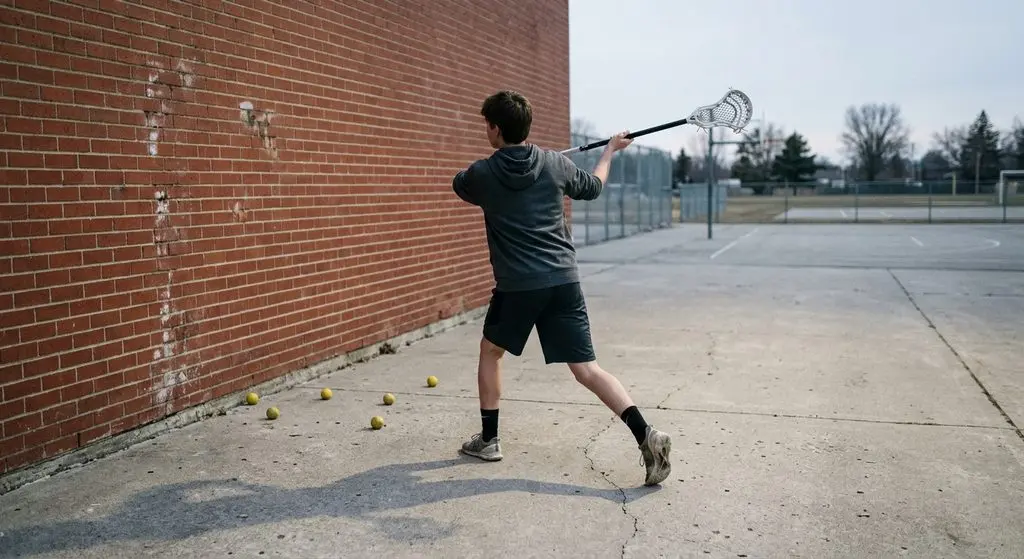
Wall ball. Not as one item on a list. As the thing, ahead of everything else.
It’s the highest-repetition activity available in the sport. A player can accumulate more catches and throws in fifteen minutes against a wall than in a full team practice, because a team practice is mostly queueing, listening and running.
The rep counts are worth borrowing from programs that publish them. Hopkinton Youth Lacrosse’s routine is 15 minutes a day, five days a week, 400 reps, standing 10 to 12 feet out. And critically, it weights the weak hand two to one against the strong hand. That ratio is the single most useful thing on this page for a late starter, because the off hand is where the gap is widest and where improvement shows fastest.
There’s also a useful counter-argument worth knowing about. USA Lacrosse published guidance from Roy Colsey, a National Lacrosse Hall of Fame player, suggesting that players building form should drop the catch entirely at first and just throw at the wall repeatedly. On the reasoning that chasing a rep target turns the session into a catching drill and a nervous player tenses up. For someone genuinely new, that’s a sensible way to start before adding the catch back in.
The full routine, rep counts and the reasoning behind both approaches are in the wall ball guide.
Starting lacrosse late: what to learn, in what order
Resist the temptation to work on everything. The order matters more than the volume.
1. Catching, both hands. Before anything else. A player who can’t catch reliably can’t participate in most drills, which compounds the problem socially as well as technically.
2. Throwing accurately at short range. Not far. Accurately. Distance comes later and comes easily.
3. Ground balls. The most learnable skill in the sport and the one that gets a late starter onto the field fastest, because it’s mostly willingness. Coaches notice it immediately.
4. Cradling while moving. Then while changing direction, then under light pressure.
5. Shooting. Last, genuinely. Shooting is the fun one and it’s the one most late starters want to start with, but shooting before the hands are reliable just builds a shot you can’t set up.
If you’re at stage five and want structure, matching a shooting target to your actual level rather than your aspirational one matters more for a late starter than anyone. A target that’s too hard produces a low hit rate at exactly the moment motivation is fragile.
What actually helps, practically
- Buy enough balls. A player with one ball spends the session walking. This is the cheapest intervention available and it roughly doubles usable practice time.
- Find a wall you’re allowed to throw at. Brick or concrete. Not a garage door, not drywall.
- Practise daily and briefly, not weekly and long. Fifteen minutes a day beats two hours on Sunday, because the skill is built by frequency.
- Track the weak hand separately. It’s the gap, so measure it.
- Get a stick that’s strung reasonably. A badly strung pocket makes catching harder, which is a cruel thing to add to a beginner’s pile.
The wider equipment picture for someone new to the sport is covered in the essential gear guide, and balls are where a late starter’s money goes furthest.
What to expect, honestly
No timeline promises here, because they’d be invented.
What’s reasonable to say: hands improve on a scale of weeks with daily work, and the improvement is noticeable to the player before it’s noticeable to a coach. The off hand improves fastest of all, because it’s starting from nothing and everything is novel.
What’s also true: a late starter often doesn’t fully close the gap in one season, and that’s normal rather than a verdict. Plenty of players who started late became good players. The ones who did put the volume in outside of team practice, which is the only variable actually under their control.
Bottom line
Starting lacrosse late is a repetition problem wearing the costume of a talent problem. The rules won’t adjust for you, so the catching-up happens at home: wall ball daily, weak hand weighted two to one, catching before throwing and throwing long before shooting. Buy more balls than seems necessary, keep the sessions short and frequent, and measure the off hand separately, because that’s where the gap is and where it closes first.
A Word on Gladiator Lacrosse
Gladiator Lacrosse was founded in 2012 by Rachel Zietz, then a 13-year-old player in Boca Raton. Her coaches told her to play wall ball as much as possible, and the gear she could get kept falling apart, so she built her own. Equipment that makes solo repetition possible is the whole reason the company exists.
For a late starter, the useful end of the catalogue is the cheap end: a pack or box of balls so a session isn’t spent retrieving, and a shooting target matched honestly to where the player is now. Official-size goals come later, once the hands are reliable enough that shooting practice is worth the space.
You Might Also Like
- Lacrosse wall ball routine — the rep counts and the weak-hand ratio
- Essential gear for new players — what you actually need to start
- Which shooting target you need — matched to your level, not your ambition
FAQ
Is it too late to start playing lacrosse at 13 or 14? No, but it’s worth being clear about what you’re behind on. The gap is repetitions with a stick rather than athleticism or game understanding, and older beginners often arrive with better conditioning and coachability. The catch is that age-grouped rules don’t adjust for experience, so the extra reps have to come from practice at home.
What should a late starter in lacrosse learn first? Catching with both hands, before anything else. Then short-range accurate throwing, then ground balls, then cradling while moving, and shooting last. Shooting is the one most beginners want to start with, but a shot you can’t set up with reliable hands isn’t much use in a game.
How long does it take to catch up in lacrosse? There’s no honest published answer, so treat anyone giving you a specific timeline with suspicion. What’s reasonable: hands improve noticeably within weeks of daily practice, and the off hand improves fastest because it’s starting from zero. Many late starters don’t fully close the gap in one season, which is normal.
What’s the fastest way to improve at lacrosse as a beginner? Wall ball, daily and briefly. It produces more catches and throws in fifteen minutes than a full team practice does, because team sessions involve a lot of queueing and listening. Published program routines run around 15 minutes a day, five days a week, and weight the weak hand roughly two to one.
Do older beginners need different lacrosse equipment? No, and that’s part of the difficulty. Youth lacrosse groups by age rather than experience, so a player joining at an older age group uses that group’s stick specification and ball standard from their first session. There’s no beginner equipment tier, which is why home repetition matters more for late starters than for anyone else.