
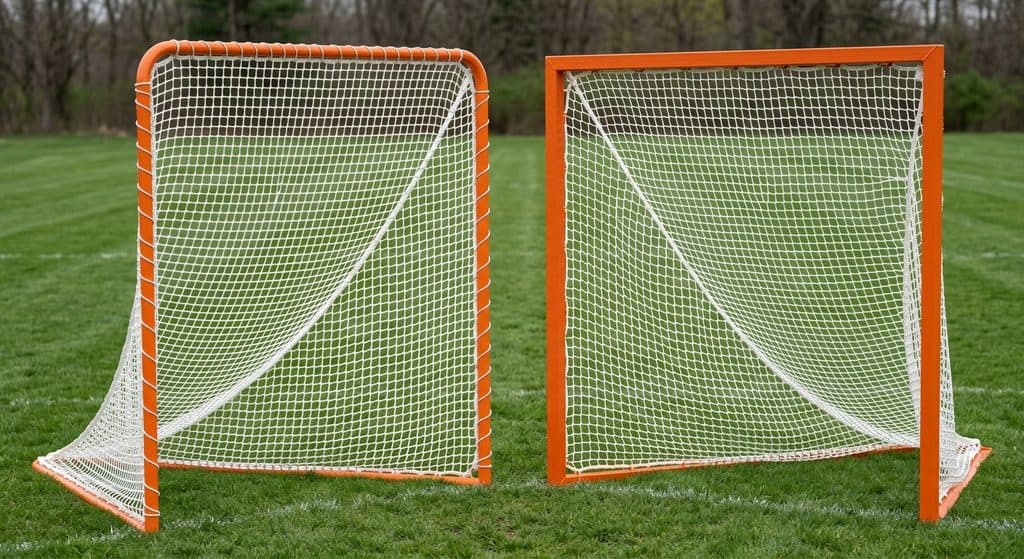
Same Size, Different Goal
Two goals, both six feet by six feet, both regulation. One is a few hundred dollars and one is several times that. Nothing about the dimensions explains the gap, so it’s reasonable to assume the expensive one is a markup on the same product.
It isn’t. A practice lacrosse goal and an official goal differ in frame gauge, and that single spec drives everything else: the weight, the corner shape, how it ships, how long it survives a squad shooting at it, and, the part nobody mentions, which replacement nets will fit it for the rest of its life. Both are regulation size.
So the real question isn’t which goal is better. It’s who’s shooting at it.
What the industry actually means by practice versus official
The dividing line is consistent enough that independent sellers publish the same numbers.
FirstTeam, a goal manufacturer, states that official goals use 1.75-inch and 2-inch diameter piping while practice goals use 1.5-inch, that official goals have squared-off welded corners where practice goals have rounded ones, and that official goals often exceed 100 pounds while portable practice goals can be as little as 15. LacrosseBallStore independently puts NCAA and professional frames in the same 1.75 to 2-inch range.
Gladiator’s catalogue sits on both sides of that line. The Official Lacrosse Goal with 6.0 mm Net is 1.5-inch steel with rounded corners at 14 pounds. The Professional Lacrosse Goal is 2-inch all-steel pipe with square welded corners at 120 pounds.
Both are 72 by 72 inches. Both are regulation. One weighs nearly nine times the other.
What the frame gauge actually buys
Half an inch of pipe diameter sounds trivial and isn’t.
Rigidity under repeated impact. A thicker tube flexes less when a ball hits it. In a backyard that barely matters; a kid shooting a few hundred times a season isn’t testing anything. On a practice field with a full squad shooting hard four days a week, flex becomes fatigue and fatigue eventually becomes a bent frame.
Weight, in both directions. The lighter frame is the one you can carry, store and take inside for winter. The heavier frame is the one that doesn’t move when something hits it, and also the one that needs two people and a freight delivery.
Assembly and shipping. Snap-together versus six-piece bolt-together. Ground shipping versus freight with charges quoted after checkout. Neither is better in the abstract; they’re different products for different situations.
For the dimensional questions, including what 6x6x7 means and which sizes youth levels actually use, the goal sizing guide covers it in full and this post won’t duplicate it.
The decision nobody tells you you’re making
Here’s the part that’s genuinely useful and that no competitor connects.
Frame gauge and corner shape are the same decision. Thicker pipe gets welded at right angles. Thinner pipe is bent through a curve. That’s why practice goals have rounded corners and official goals have square welded ones. It isn’t styling, it’s a consequence of the material.
And corner shape determines which replacement nets fit.
Which means the goal you choose today quietly commits you to buying round-corner nets or square-corner nets for as long as you own it. Nets are the recurring cost on a goal; frames outlast them by years. So you’re not just choosing a frame, you’re choosing a net format you’ll re-buy several times.
The rule that actually works: match the net to the shape of your frame. Curved top corners take a round-corner net. Welded right angles take a square-corner net. Universal and Velcro nets are cut to work with either, which is the sensible hedge if you’re running a mix of frames. Gladiator’s FAQ covers fit, and the net thickness guide covers which gauge to buy once you know the shape.
Which practice lacrosse goal situation are you in
| Your situation | What to buy | Why |
|---|---|---|
| One kid, backyard, years of use | Practice-tier, 1.5″ frame | Light enough to move and store; plenty for one player |
| Family with several players | Practice-tier | Same answer — volume is still low by program standards |
| Backyard that has to come in for winter | Practice-tier | The heavy frame doesn’t pack, and storage is what extends life |
| Club or school practice field | Program-tier, 2″ frame | Squad volume is what the heavier gauge is for |
| Hosting games | Program-tier, sold as a pair | You need two, and the spec statement matters |
| Mixed: game field plus shooting stations | Both | Heavy on the game field, practice-tier on the stations |
That last row is the one programs underuse. There’s no rule saying every goal on a site has to be the same tier, and practice-tier goals are perfectly good for shooting stations where the alternative is players queueing at the one expensive goal.
When a practice lacrosse goal is the wrong call
Being straight about it, because a post that says “buy the cheap one” every time isn’t advice.
Go heavier if a full roster is shooting at it regularly. Go heavier if it’s a game field and you need the goal to sit dead still. Go heavier if it lives on a school site where equipment gets handled by people who didn’t buy it.
Stay with the practice-tier frame if a backyard, one or two players, and the ability to move and store the thing are your actual constraints. Buying a 120-pound goal for a garden is buying a goal you’ll never reposition and never bring inside, which costs you more in net life than the frame upgrade gains you.
The full goal range spans both ends.
Bottom line
Practice and official goals are the same regulation size and a different build, and the frame gauge is the whole difference. Buy on who’s shooting at it, not on budget alone. And go in knowing that the corner shape comes attached to the gauge, which means you’re picking the replacement net format you’ll be buying for years, so match the net to the frame shape, and let the thickness decision follow your weather.
A Word on Gladiator Lacrosse
Gladiator Lacrosse was founded in 2012 by Rachel Zietz, then a 13-year-old player in Boca Raton who couldn’t find backyard equipment that survived being used. The catalogue is lacrosse-only and spans both ends of this decision: official-size steel-framed goals, replacement nets in four twine thicknesses, NOCSAE-standard SEI-certified balls, shooting targets and rebounders.
The Official Lacrosse Goal with 6.0 mm Net is the backyard-tier build: regulation 72 by 72 inches, 1.5-inch steel, rounded corners, snap-together, 14 pounds. The Professional Lacrosse Goal with 6 mm White Net is the program build: 2-inch steel, square welded corners with welded lacing bars, stated to meet NCAA and NFHS specifications, sold single or as a pair.
You Might Also Like
- Lacrosse goals — both tiers with full specs
- What size lacrosse goal you need — dimensions, 6x6x7, and youth sizes
- Lacrosse net thickness explained — the net decision your frame choice sets up
FAQ
What’s the difference between a practice lacrosse goal and an official goal? Frame gauge, and everything that follows from it. Industry sellers put practice goals at 1.5-inch piping with rounded corners and official goals at 1.75 to 2 inches with squared welded corners, with official goals often over 100 pounds. Both are the same regulation 6 feet by 6 feet; the difference is build, not size.
Is a practice lacrosse goal regulation size? Yes. A practice-tier goal can be full regulation 72 by 72 inches while using a lighter frame. Regulation is about the goal’s dimensions and the net’s mesh, not about how thick the pipe is. What the lighter gauge changes is durability under heavy volume, weight, and how it ships.
Do I need an official goal for a backyard? Almost never. A practice-tier frame handles one or two players shooting for years, and its real advantage is that you can move it and store it — which does more for the goal’s lifespan than extra steel would. The heavier frame is for squad volume, game fields and school sites.
Does the goal I buy affect which replacement nets fit? Yes, and this is the part people miss. Frame gauge and corner shape come together: thicker pipe is welded at right angles, thinner pipe is bent round. So a practice-tier goal takes round-corner nets and a program goal takes square-corner nets, for as long as you own it. Universal and Velcro nets fit either.
Can a program mix practice goals and official goals? Yes, and more should. There’s no rule that every goal on a site must be the same tier. The heavier frames belong on the game field where they need to sit still, while practice-tier goals work perfectly well for shooting stations — which beats a whole squad queueing at the one expensive goal.