
“Portable” Is Doing a Lot of Work in That Product Listing
Search for a goal you can move and you’ll get pop-up nets that fold into a bag, steel goals that come apart into a long box, and full-size goals that weigh more than the person buying them. All three are listed as portable. All three are ranked against each other in the same review articles.
A portable lacrosse goal is one of three quite different things. It might fold with the net attached, like a pop-up. It might disassemble into a carton and rebuild in minutes, which is what a snap-together steel goal does. Or it might simply be movable — a full-size frame you can reposition across a field but never pack away. Portability trades against frame strength, so the question is which kind you actually want.
Getting that wrong is how people end up with a fiberglass pop-up when what they wanted was a goal that survives a winter.
The three meanings, side by side
| Folding | Disassembling | Movable | |
|---|---|---|---|
| What it does | Collapses with the net attached | Comes apart into pieces, rebuilds in minutes | Gets repositioned, never packed |
| Typical build | Fiberglass or thin tube | Snap-together steel | Heavy welded steel |
| Setup time | Seconds | Minutes | It’s already up |
| Stores in | A carry bag | A long carton or a shelf | Nowhere — it stays out |
| Survives a season outdoors | Often not | Yes | Yes |
| Gladiator makes one? | No | Yes — the backyard goals | Yes — the Professional |
Worth saying plainly: Gladiator doesn’t make a folding pop-up goal. If a goal that collapses into a shoulder bag in ten seconds is what you need, say for a coach running sessions at three different parks, that’s a real requirement and this isn’t the brand for it.
What Gladiator makes is the other two, and for a backyard the distinction between them is the whole decision.
What a disassembling portable lacrosse goal actually gives you
This is the category most backyard buyers actually want without knowing there’s a name for it.
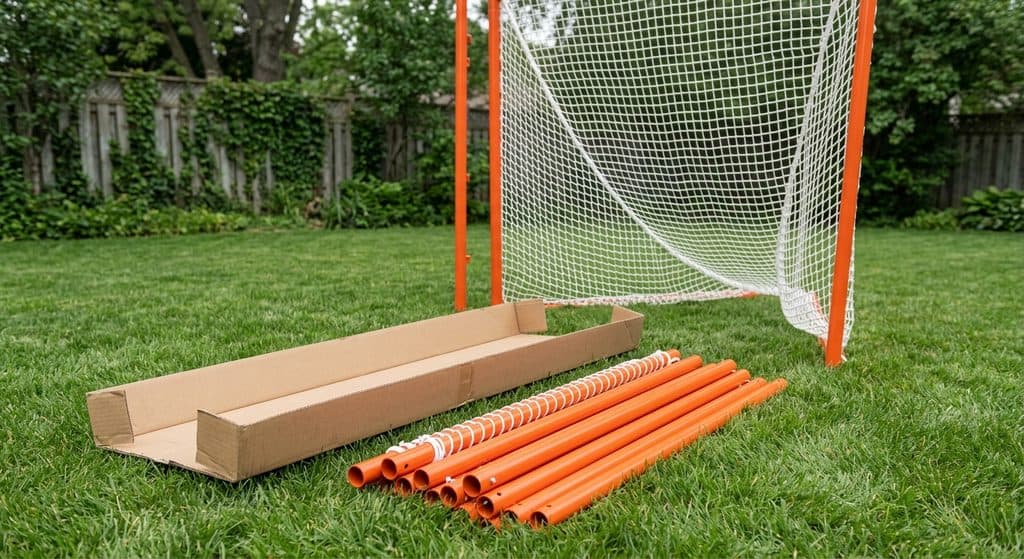
The Gladiator Lacrosse® Official Lacrosse Goal with 6.0 mm Net is a full regulation 72 by 72 inches on a 1.5-inch steel frame, and it weighs 14 pounds. It arrives in a carton about 42 inches long and goes together with snap connections, no tools.
Those numbers do more work than they look like they do.
14 pounds means one adult can reposition it without a second person, and a teenager can move it to mow the lawn. That’s the difference between a goal that gets used where it suits the session and one that lives permanently in the one spot it was first assembled.
A 42-inch carton means it goes in a car. Not a trailer, a car. So it travels to a grandparent’s house for the summer, and more importantly it goes into a garage for the winter instead of sitting under snow, which is the single biggest thing you can do for a goal’s lifespan.
Snap-together assembly means taking it down isn’t a project. A goal that takes an hour to disassemble never gets disassembled.
The trade is honest: a 1.5-inch frame is a backyard frame. It takes a kid shooting for years. It is not built for a full roster shooting hard at it four days a week.
When you want the heavy one instead
The Gladiator Lacrosse® Professional Lacrosse Goal with 6 mm White Net is the other kind of portable, which is to say barely portable at all.
Two-inch all-steel pipe, square welded corners, six-piece construction with a manual, and 120 pounds. It states that it meets NCAA and NFHS specifications, and it’s sold as a single or a pair, which is what you need to host anything.
Three practical consequences worth knowing before you buy:
It ships freight. The product page states that additional freight charges are required and that you’ll be contacted after checkout. That’s normal for a 120-pound steel product and it’s better to know than to discover.
It’s a two-person move. Not a warning, just planning. Decide where it lives before it arrives.
It doesn’t pack. The 96-inch shipping carton is a clue. This is a goal that stays up.
If you’re weighing the two, the honest test isn’t budget. It’s who’s shooting at it. A backyard goal handles a dedicated kid for years. A program goal handles a squad. Buying the lighter frame for a program is a false economy, and buying the heavier one for a backyard is buying a thing you can never move.
What a portable lacrosse goal costs you in steel
The trade-off nobody states directly.
Portability comes from less material, thinner tube, and joints instead of welds. Every one of those makes the goal lighter and every one makes it less rigid. That’s not a defect, it’s the deal. A goal you can carry is a goal with less steel in it.
Which means the useful question isn’t “how portable is it” but “how portable do I need it to be, and what am I giving up to get there.” For most families the answer lands on a disassembling steel goal: light enough to move and store, solid enough to leave out through a season.
Pop-ups sit at the far end of that trade. They’re genuinely convenient and they’re genuinely less durable, and anyone telling you otherwise is selling one.
For the dimensional side of the decision, including regulation sizes and where youth sizes differ, the goal sizing guide covers it properly and this post won’t repeat it.
A quick way to decide
Four questions, in order:
- Does it need to move between locations regularly? If yes and you can’t fit a 42-inch carton in the car, you want a folding goal, and you’ll accept the durability trade.
- Does it need to come inside for winter? If yes, a disassembling steel goal is the answer, and the carton length is the spec to check.
- Is a squad shooting at it? If yes, go heavy and plan for freight and a two-person move.
- Is it going up once and staying there? Then portability barely matters and you should buy on frame gauge instead.
The whole goal range spans those cases, and the assembly side is covered in the assembly instructions.
Bottom line
Decide which kind of portable you mean before you shop, because the word covers three products that aren’t substitutes. Folding goals travel and don’t last. Snap-together steel goals store and travel in a car while surviving a season outside, which is what most backyards want. Movable program goals don’t pack at all and ship freight. Portability is bought with steel, so pick the point on that trade you actually need.
A Word on Gladiator Lacrosse
Gladiator Lacrosse was founded in 2012 by Rachel Zietz, then a 13-year-old player in Boca Raton who couldn’t find backyard equipment that survived being left outside. The catalogue is lacrosse-only: official-size steel-framed goals, replacement nets in four twine thicknesses, NOCSAE-standard SEI-certified balls, shooting targets and rebounders.
The Official Lacrosse Goal with 6.0 mm Net is the disassembling backyard option: regulation 72 by 72 inches, 1.5-inch steel, 14 pounds, snap-together, and it ships in a carton that fits a car. The Professional Lacrosse Goal is the program-grade frame at 2-inch steel and 120 pounds, sold single or in pairs.
You Might Also Like
- Lacrosse goals — the full range, backyard through program-tier
- What size lacrosse goal you need — regulation dimensions and youth sizes
- Assembly instructions — setup guides by product
FAQ
What does portable mean on a lacrosse goal? Three different things, which is why the word is unreliable. It can mean a folding goal that collapses with the net attached, a snap-together goal that disassembles into a carton and rebuilds in minutes, or a full-size goal that can be repositioned but never packed away. They aren’t substitutes for each other.
Are portable lacrosse goals regulation size? Some are and some aren’t. A snap-together steel goal can be full regulation 6 feet by 6 feet while still coming apart for storage, and Gladiator’s backyard goals are exactly that. Folding pop-up goals are often smaller than regulation. Check the stated dimensions rather than assuming portability means undersized.
How much does a portable lacrosse goal weigh? It depends which kind. A disassembling backyard steel goal is light enough for one person to move — Gladiator’s Official Goal with 6.0 mm net is 14 pounds. A movable program goal is a different category: the Professional Goal is 120 pounds and needs two people plus freight delivery.
Can you take a lacrosse goal apart for winter? Yes, if it’s a snap-together design. Gladiator’s backyard goals use snap connections and no tools, and they pack back into a carton around 42 inches long. Storing the goal over winter, or at minimum storing the net, does more for its lifespan than anything else you can do.
Does Gladiator make a folding pop-up lacrosse goal? No. The backyard goals disassemble into a carton rather than folding with the net attached, and the Professional goal doesn’t pack at all. If you specifically need a goal that collapses into a carry bag in seconds, that’s a different product category with a real durability trade-off attached.