
Every Number You’ve Read About This Was Made Up
Search the cost of youth lacrosse and you’ll get confident totals. Twelve hundred a year. Two thousand. Five thousand for travel. They’re stated flatly, with no source, and they vary by a factor of four.
So here’s the honest answer to how much does lacrosse cost: nobody has actually measured it. The most credible research on youth sports spending, the Aspen Institute’s Project Play parent survey, has sized soccer, basketball, baseball and football. And never lacrosse. Which means every lacrosse total you’ve seen is someone’s estimate presented as a fact. What you can do instead is build the number yourself from line items that are real, and separate the things you buy once from the things you pay every year.
That second distinction is the one that actually changes the maths.
What the research does and doesn’t say
Worth being precise, because this is where most articles quietly cheat.
Project Play’s National Youth Sports Parent Survey reported that families spent an average of $1,016 on a child’s primary sport in 2024, up 46% since 2019, and around $1,500 across all sports a child plays. That’s a real, sourced figure and it’s a useful anchor for what youth sport costs in general.
Its Fall 2022 wave broke costs down by sport: soccer $1,188, basketball $1,002, baseball $714, tackle football $581. The 2024 wave covered baseball, soccer and basketball.
Lacrosse appears in neither. Not because it’s cheap or expensive, but because it wasn’t sized.
So the honest position is that lacrosse probably sits somewhere in the general range of organised youth sport, with equipment costs at the higher end because the sport requires more of it, and with a very wide spread depending on whether you’re in rec or travel. Anyone giving you a tighter answer than that is guessing.
How much does lacrosse cost, line item by line item
Build your own number from these. All of them are checkable; none of them requires trusting a blog.
Registration or league fees. Varies enormously by program and region. This is your single biggest variable and it’s the one you can find out exactly, today, by looking at your local club’s page.
Governing body membership. USA Lacrosse publishes its prices: a youth Field Pass at $40 a year and High Performance membership at $75 a year, which include accident and liability insurance. Most cost articles skip membership entirely, which is odd given it’s one of the few genuinely fixed and knowable numbers in the whole exercise.
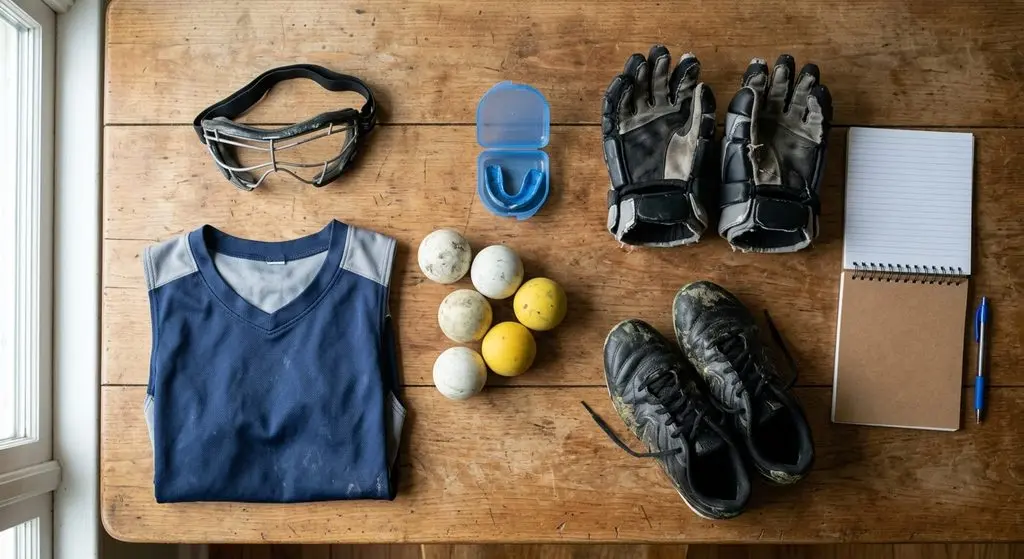
Required protective equipment. What’s mandatory depends on which game and which level. The boys’ game requires substantially more than the girls’ game, where field players need eye protection and a mouthguard rather than a helmet and pads. Both games’ rulebooks set out exactly what’s required, and it’s worth reading your level’s rather than buying from a generic checklist.
A stick. Preference-heavy and level-dependent, and the one item where growth genuinely forces replacement.
Travel. The line item that separates a rec season from a club season, and often the one that dwarfs everything above. Hotels, fuel, tournament entry, meals. Nobody budgets this accurately the first year.
Practice equipment at home. Optional, and treated as such below.
Buy once versus buy every year
Here’s the split that makes the number manageable, and almost nobody writes it down.
| Recurring, every season | Buy once, lasts years |
|---|---|
| Registration and league fees | A backyard goal |
| Governing body membership | Replacement nets (a few seasons each) |
| Travel, hotels, tournament entry | Shooting targets |
| Outgrown protective gear and cleats | Balls (they wear, but slowly) |
| Sticks, as the player grows | A ball bag |
The recurring column is where the money actually goes, and it’s largely not equipment. The buy-once column is smaller than people expect and it amortises across seasons in a way fees never do.
Which is why the sharpest question for a family watching costs isn’t “how do I spend less on gear.” It’s “what can I buy once that reduces what I need to pay for repeatedly.” Home practice equipment is the honest answer to that. A goal or a target in the yard is a one-time cost that substitutes for some portion of paid clinic time, and it keeps working for years after.
That’s the only part of this post where the equipment argument belongs, and it’s worth being clear that it’s a partial substitute rather than a replacement for coaching.
How much does lacrosse cost in year one, realistically
The honest framework for a first season, in order of size:
- Find out your program’s actual fee. This is knowable today and it anchors everything. Rec, school and club differ by a lot.
- Add membership. $40 or $75 a year at published USA Lacrosse rates, depending on level.
- Price the required protective gear for your specific game and level. Not a generic list. The boys’ and girls’ requirements genuinely differ.
- Add a stick.
- Estimate travel honestly, or decide you’re not doing travel this year. This is the swing factor.
- Decide on home equipment separately, after a season. See below.
Do that and you’ll have a real number for your family rather than a national average that doesn’t describe anyone.
What not to buy in year one
Worth saying, because a cost article that recommends buying things isn’t a cost article.
Don’t buy a goal in the first season. Buy it when the player practises without being asked. Equipment multiplies an existing habit rather than creating one, and a goal bought for a kid who’s still deciding whether they like the sport is the most expensive way to find out.
Don’t buy the advanced version of anything. This applies to targets especially. A target that’s too demanding lowers the hit rate until practice stops being fun.
Don’t buy sized gear as a gift or in advance. Gloves, cleats and helmets are fitted items and kids grow unpredictably.
Do buy more balls than you think. It’s the cheapest thing on any lacrosse list and it’s the one that most changes how much a player actually practises, because a kid with one ball spends the session retrieving it.
If and when the home-equipment question becomes live, the goal sizing guide and the targets guide cover choosing without overbuying. For the season-one questions generally, the parent’s guide to youth lacrosse is a better starting point than any cost list.
Bottom line
There’s no published figure for what lacrosse costs, so build your own from your program’s actual fee, published membership rates, your level’s required equipment, and an honest travel estimate. Separate the annual costs from the one-time ones, because the annual column is where the money really goes. And leave the home equipment decision until after a season, when you know whether the habit is there.
A Word on Gladiator Lacrosse
Gladiator Lacrosse was founded in 2012 by Rachel Zietz, then a 13-year-old player in Boca Raton who couldn’t find backyard equipment that survived being left outside. Gear that failed early is expensive gear, whatever it cost. The catalogue is lacrosse-only: official-size steel-framed goals, replacement nets in four twine thicknesses, NOCSAE-standard SEI-certified balls, shooting targets and rebounders.
Everything in that list sits in the buy-once column, which is the point. A regulation goal lasts years and its nets are replaceable rather than the whole unit, and a pack of balls is the cheapest thing a family can buy that measurably increases how much a player practises.
You Might Also Like
- Parent’s guide to youth lacrosse — the season-one questions beyond cost
- What size lacrosse goal you need — for when the home equipment question comes up
- Which shooting target you need — how to avoid overbuying
FAQ
How much does lacrosse cost per year? There’s no authoritative figure, because the main research on youth sports spending has never sized lacrosse. The Aspen Institute’s Project Play survey covered soccer, basketball, baseball and football, and reported an average of $1,016 on a child’s primary sport in 2024. For lacrosse specifically, build your own number from your program’s fee, membership, required gear and travel.
Why is there no official cost of lacrosse figure? Because nobody has measured it. Project Play’s parent survey, the most credible source on youth sports spending, sized four sports in its 2022 wave and three in 2024, and lacrosse was in neither. Any specific total you see online is an estimate presented as a fact.
What’s the most expensive part of playing lacrosse? Usually travel, if the family plays club or tournament lacrosse. Hotels, fuel, tournament entry and meals routinely exceed registration and equipment combined, and it’s the line item families underestimate most in a first season. For rec and school lacrosse, registration fees are typically the largest single cost.
How much is USA Lacrosse membership? USA Lacrosse publishes a youth Field Pass at $40 a year and a High Performance membership at $75 a year, both including accident and liability insurance. It’s one of the few genuinely fixed and knowable numbers in a lacrosse budget, and most cost articles leave it out entirely.
Do you need a lacrosse goal at home? Not in the first season. A goal is a buy-once cost that lasts years, but it multiplies an existing practice habit rather than creating one. The sensible order is to buy balls first, see whether the player practises without being asked, and revisit the goal question after a full season.