
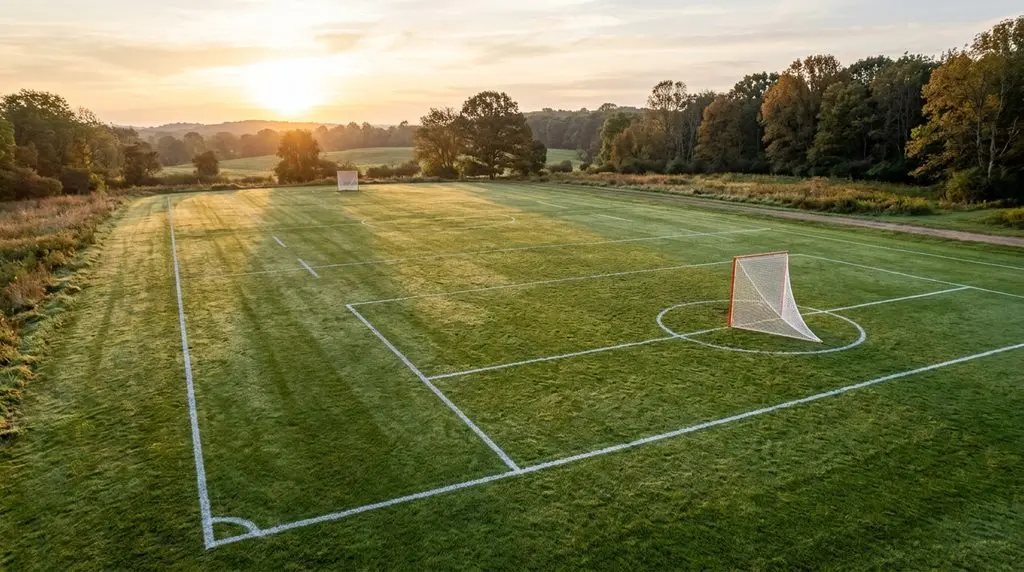
The Men’s and Women’s Fields Aren’t the Same Shape, and It’s Not Just the Size
Most pages about lacrosse field dimensions give you one number — 110 by 60 — and stop. That’s the men’s field, and it’s correct as far as it goes. It’s also not the field a women’s team plays on, not the field a 10U team plays on, and not the whole answer for anyone trying to line a field or explain to a parent why the markings look different at the girls’ game.
A men’s lacrosse field is 110 yards long and 60 yards wide, with goals 80 yards apart and 15 yards of playable space behind each one. A women’s field is larger: optimally 120 yards long and 65 yards wide, with goals 100 yards apart. The goals themselves are identical at 6 feet by 6 feet in both games — it’s the space around them that differs.
That gap between the two games is the part nobody explains, so let’s do it properly.
The men’s field, from the governing body
USA Lacrosse’s field-lining guidance states that the playing area shall be rectangular, 110 yards in length and 60 yards in width. It adds a practical allowance that matters to a lot of schools: institutions may vary only the width, to between 53 1/3 yards and 60 yards, to fit existing field restrictions like football sidelines.
That’s why so many high school lacrosse fields look narrow. They’re sharing lines with a football field, and the width is the only dimension allowed to flex.
The rest of the men’s markings:
- Goal line — 15 yards in from the end line, which puts the two goals 80 yards apart and leaves real playing space behind the cage
- Goal crease — a plainly marked circle drawn with a 9-foot radius from the midpoint of the goal line, so 18 feet across
- Restraining lines — marked 20 yards from and parallel to each goal line, extending sideline to sideline
- Goal area — a 40-yard line centered on the goal, 20 yards out, with lines drawn back to the end line
- Wing areas — lines 20 yards from the center of the field, extending 10 yards each side of the center line
The 15 yards behind the goal is the detail that surprises people coming from soccer or football. Lacrosse is played behind the net, which is why “X” is a position description and not just a spot on a diagram.
The women’s field, from the NCAA rulebook
The NCAA women’s rulebook sets optimal dimensions of 60 metres (65 yards) in width and 110 metres (120 yards) in total length, with goals 92 metres (100 yards) apart. Where that can’t be met, the field shall be between 110 and 120 yards end line to end line and between 60 and 70 yards sideline to sideline, with goals placed no more than 100 yards and no less than 90 yards apart.
It also requires 10 yards of space behind each goal line, running the full width of the field.
And here’s the difference that actually changes how the game looks: the women’s restraining line is a solid line 30 yards upfield from each goal line. The men’s is 20. That single ten-yard difference is why the women’s game has a deeper settled offensive zone and why the two fields don’t overlay onto each other cleanly even when the outer dimensions are similar.
Side by side
| Men’s (NCAA / USA Lacrosse) | Women’s (NCAA) | |
|---|---|---|
| Length | 110 yards | 120 yards optimal (110–120 permitted) |
| Width | 60 yards (may narrow to 53 1/3) | 65 yards optimal (60–70 permitted) |
| Goal to goal | 80 yards | 100 yards optimal (90–100 permitted) |
| Space behind goal | 15 yards | Minimum 10 yards |
| Restraining line | 20 yards from goal line | 30 yards from goal line |
| Goal size | 6 ft x 6 ft | 6 ft x 6 ft |
| Crease | 9-foot radius circle | Goal circle around each goal |
| Players | 10 v 10 | 12 v 12 |
The row to remember is the last-but-one. The goals are the same in both games. A 6×6 goal is a 6×6 goal whether it’s a boys’ high school field or an NCAA women’s championship, which is the reason a single official-size goal serves a household with kids in both games. If you want the detail on why the third number in “6x6x7” isn’t the depth of the frame, that’s covered in the goal sizing guide.
Youth fields are deliberately smaller
Youth lacrosse doesn’t play on a shrunken version of the adult field. It plays a different game on a different footprint, and USA Lacrosse recommends small-sided play for the 10U, 8U and 6U brackets specifically.
Under the 2026 USA Lacrosse boys’ youth rules, 6U and 8U play 4v4 cross-field on a maximum playing area of 60 to 70 yards long by 35 to 45 yards wide, with no restraining line required. Flat disc cones are explicitly permitted to mark the area if lining a field isn’t practical. 10U plays 6v6 or 7v7 on a similar cross-field footprint. 12U runs 7v7 cross-field or 10v10 full field, and 14U plays full-field 10v10.
Cross-field is the key idea and it’s an elegant one: you take one full-size field and run two or three small games across its width, which multiplies touches and removes the sight of eight-year-olds jogging 110 yards away from the ball.
The girls’ youth ladder is structured differently again, with its own recommended field sizes by level, so don’t assume the boys’ numbers transfer.
If you’re lining a field
Two things from the official guidance that save a lot of repainting.
Measure from the right part of the line. USA Lacrosse specifies which edge to measure from: inside measurements for sidelines and end lines, outside for the crease, goal area and wing area lines, and centre measurements for the goal line and centre line. Lines are 2 to 4 inches wide, so getting this wrong compounds across a field.
Get the corners square first. The recommended method is the 3-4-5 triangle: mark a point along the end line, run one string of 5 units from it and a second of 3 units from the corner, and where they intersect is a true perpendicular. Do both sidelines that way and the field will still be the right width when you reach the far end.
The official painting order is end line, first sideline, second end line, last sideline, then goal line and crease, then restraining lines, then everything else.
What this means for a backyard
Almost nothing, and that’s the point worth saying out loud.
Nobody needs 110 yards to practise. What a backyard needs is enough room to shoot from a realistic distance without the ball ending up in a neighbour’s garden, plus enough space behind the goal for the net to be staked. The field dimensions matter for understanding the game, for lining a real field, and for knowing that the goal in your yard is the same 6×6 the varsity team shoots at. They don’t set a minimum for a driveway session.
If you’re working out whether your yard is big enough, the backyard setup guide deals with the actual constraints — space behind the cage, surface, and stopping the ball.
Bottom line
Men’s: 110 by 60, goals 80 yards apart, 15 yards behind each cage, restraining line 20 yards out. Women’s: 120 by 65 optimally, goals 100 yards apart, 10 yards behind, restraining line 30 yards out. Youth: small-sided and cross-field by design, 60 to 70 by 35 to 45 at the youngest brackets. The one constant across every level and both games is the goal itself — 6 feet by 6 feet, everywhere.
A Word on Gladiator Lacrosse
Gladiator Lacrosse was founded in 2012 in Boca Raton by Rachel Zietz, a 13-year-old player who wanted backyard equipment that matched what she played on and didn’t fall apart outside.
That’s still the logic of the catalog. The Gladiator Lacrosse® Official Lacrosse Goal with 6mm Net is official 72″ x 72″ on a 1.5″ all-steel frame that snaps together, which means the cage in the yard is the same size as the one on the field. For programs lining and playing on a real field, the Gladiator Lacrosse® Professional Goal with 6 mm White Net is built on 2-inch steel pipe with welded lacing bars, states that it meets NCAA and NFHS specifications, and is sold singly or as a pair — which is how you actually outfit a field.
You Might Also Like
- What size goal you need and what 6x6x7 means — the spec people misread most
- Youth lacrosse age groups explained — what changes at 6U, 10U and 12U
- Setting up a backyard for lacrosse — space, surface and stopping the ball
FAQ
How big is a lacrosse field? A men’s field is 110 yards long and 60 yards wide, with goals 80 yards apart and 15 yards of playing space behind each goal. A women’s field is optimally 120 yards long and 65 yards wide with goals 100 yards apart. Men’s fields may be narrowed to 53 1/3 yards where existing facilities require it.
Are men’s and women’s lacrosse fields the same size? No. The women’s field is longer and wider, the goals are further apart, and the restraining line sits 30 yards from the goal line rather than 20. The goals themselves are identical at 6 feet by 6 feet in both games.
How far is the lacrosse goal from the end line? On a men’s field, the goal line is 15 yards in from the end line, which leaves 15 yards of playable space behind the cage. Women’s rules require a minimum of 10 yards behind each goal line. Lacrosse is played behind the goal, so that space is part of the field.
How big is the crease in men’s lacrosse? The goal crease is a circle drawn with a 9-foot radius from the midpoint of the goal line, making it 18 feet across. USA Lacrosse’s lining guidance specifies that the area inside the crease is not painted.
What size field does youth lacrosse use? Under USA Lacrosse’s 2026 boys’ youth rules, 6U, 8U and 10U play small-sided cross-field games on a maximum area of 60 to 70 yards by 35 to 45 yards. 12U plays 7v7 cross-field or 10v10 full field, and 14U plays full field. Cones may be used instead of painted lines at the youngest levels.