
Nobody Publishes a Minimum Yard Size, So Let’s Work It Out Properly
The question comes up before every goal purchase: is my yard big enough? And the honest starting point is that no governing body answers it. There’s no official minimum for a backyard lacrosse setup, because rulebooks describe fields, not gardens. Every confident number you’ll find online traces back to somebody selling goals.
So here’s the reasoning instead. A 6×6 goal needs roughly 7 feet of clear space behind it for the net to sit and be staked properly, a few feet on each side, and enough room in front to shoot from a realistic distance — call it 15 to 20 yards if you have it. Below that you can still run a genuinely useful practice; you just shift from shooting practice to stick work, which is where most improvement comes from anyway.
That reframe is the most useful thing on this page. A small yard isn’t a failed shooting setup. It’s a very good wall ball setup.
The space the goal itself occupies
Start with the footprint rather than the yard.
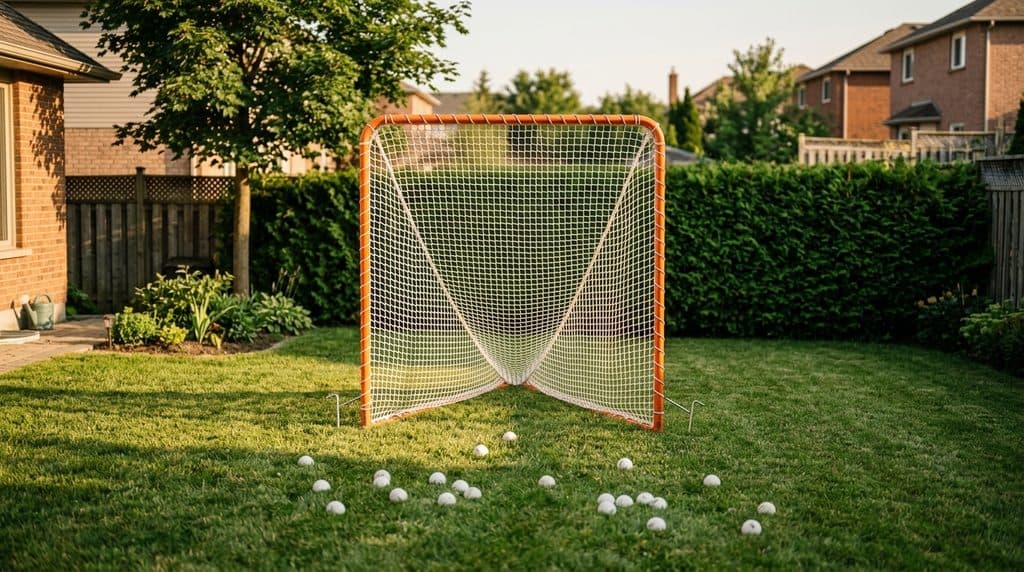
A regulation goal is 6 feet wide and 6 feet high at the opening. The net runs back behind it in a pyramid and gets fastened down — in the men’s rules, the netting extends and is fastened to the ground 7 feet back from the centre of the goal line. That’s where the “7” in 6x6x7 comes from, and it’s explained properly in the goal sizing guide.
So your real footprint is about 6 feet wide by 7 feet deep, plus clearance to walk around it. Fence-to-goal, leave a couple of feet — a net pressed against a fence chafes and wears at exactly the point you can’t see.
How much room in front
This is where you decide what kind of practice the yard supports.
| Space in front of the goal | What it’s genuinely good for |
|---|---|
| Under 10 yards | Quick-stick work, close-range finishing, passing, ground balls |
| 10–15 yards | Most youth shooting, crease finishing, target work |
| 15–20 yards | Realistic shooting practice for 12U and up |
| 20 yards+ | Time-and-room shooting, long-range work |
Published wall ball distances are a useful sanity check here, because they’re the one set of numbers that programs do publish: routines commonly put players 10 to 12 feet from the wall for standard reps, 3 to 5 yards for quick stick, and 12 to 15 yards for shooting. If 12 to 15 yards is what a program uses for shooting work against a wall, a yard offering that much is doing fine.
If you’ve got less, don’t buy a goal first. Buy balls and use a wall.
Surface
Four realistic options and what each costs you.
Grass. The default and the best for a goal. Stakes hold, the goal sits level, and balls don’t skip unpredictably. Downside: you will kill a patch of grass in front of the cage. Move the goal a few feet every couple of weeks and it recovers.
Artificial turf. Excellent if you have it. Can’t stake into it in the usual way, so you’ll need weights or sandbags on the rear ground bars instead.
Concrete or asphalt driveway. Very common and perfectly workable, with three caveats. Staking isn’t an option, so the goal needs weighting. Balls bounce hard and travel, so you need something behind the goal. And a hard surface is much rougher on balls — scuffing accelerates.
Gravel or dirt. Fine for the goal, poor for the balls, and rough on sticks during ground ball work.
Stopping the ball is the whole problem
Every backyard setup fails in the same place: the shots that miss.
A 6×6 goal catches everything on target. The issue is the ones that aren’t, and a missed shot from 15 yards is travelling fast enough to break a window, dent a car panel or clear a fence into a neighbour’s garden. Solve this before the first session, not after the first apology.
Realistic options, roughly in order of cost:
- Aim the setup at the least fragile direction. Free, and more effective than anything else. Shoot toward a hedge, a solid fence, a bank, or the side of a garage with no windows.
- Use a shooting target. Counter-intuitive but real: a target narrows where a player aims and raises accuracy, so fewer shots spray wide in the first place. A beginner-level target that blocks the middle and leaves large corner openings is the right starting point — the progression between target types is covered in the shooting targets guide.
- Hang a backstop. Heavy netting or a tarp behind the goal. The single most effective purchase for a small yard.
- Add a rebounder to the setup. A rebounder changes the activity entirely — the ball comes back to you instead of past you — which is why it’s often the better first purchase for a tight space.
Keeping the goal where you put it
Two genuinely different risks, and they get conflated.
Wind. A lightweight backyard goal with a net acts like a sail. An unanchored goal will move across a yard in a storm and can end up in a fence or a car. Stake it, or weight the rear ground bars.
Tip-over. The serious one, and it’s worth being precise rather than alarmist. The US Consumer Product Safety Commission’s guidance on movable goals is written about soccer goals typically weighing 150 to 500 pounds, and documents deaths and serious injuries caused by children climbing on goals or hanging from the crossbar. A 14-pound backyard lacrosse goal is not in that weight class and doesn’t carry the same crushing hazard. A 120-pound full professional goal is much closer to it.
The CPSC’s practical advice transfers cleanly to any goal regardless of weight, and it’s sensible:
- Anchor or counterweight the goal, securing it at the rear
- Never let anyone climb on the net or hang from the crossbar
- Use goals only on level ground
- Check connecting hardware before use and replace damaged fasteners
- Remove nets when the goal isn’t in use
- Fully disassemble for seasonal storage
That last pair matters in a backyard more than on a field. A net left on all winter is the fastest way to ruin one, which the goal maintenance and storage guide goes into properly.
For securing the net itself, bungee fastener cords are quicker to work with than lacing cord when you’re putting a net on and taking it off seasonally.
A realistic small-yard setup
If your yard is genuinely tight, here’s the order that gets the most practice out of it:
- Balls. More than you think. A player with two balls spends the session walking.
- A wall or a rebounder. The highest-repetition activity in the sport, and it needs almost no space.
- A target. Improves accuracy, which reduces the shots that go where you don’t want them.
- The goal. Once there’s room to shoot from a distance that resembles a game.
Plenty of very good players grew up with nothing but a ball and a brick wall. The goal is the nice-to-have.
Bottom line
Allow roughly 6 feet wide by 7 feet deep for the goal and its staked net, plus clearance. Fifteen to twenty yards in front supports realistic shooting; less than ten turns the space into a stick-skills setup, which is fine and arguably more valuable. Solve the missed shots before the first session by aiming at something forgiving and hanging a backstop. Anchor the goal, never let anyone hang off the crossbar, and take the net off when the season ends.
A Word on Gladiator Lacrosse
Gladiator Lacrosse exists because of a backyard. Rachel Zietz founded the company in 2012 at 13, in Boca Raton, after the goals and rebounders she could buy either cost too much or fell apart from being left outside — which is the exact failure mode a backyard setup punishes.
The Gladiator Lacrosse® Official Lacrosse Goal with 6mm Net is official 72″ x 72″ on a 1.5″ all-steel frame with snap-together assembly, so it comes apart for winter rather than rusting in place. Targets do more for a small yard than most people expect, and bungee fastener cords make putting the net on and off a seasonal job rather than an ordeal.
You Might Also Like
- What size goal you need — including what the 7 actually refers to
- Goal maintenance and off-season storage — keeping it alive outdoors
- Practice goal or official goal — which one your yard actually needs
FAQ
How much space do you need for a backyard lacrosse goal? Allow about 6 feet of width and 7 feet of depth for the goal and its staked net, plus clearance to walk around it. For shooting practice, 15 to 20 yards in front is realistic for older players, while under 10 yards suits close-range finishing and stick work. No governing body publishes an official minimum.
Can you put a lacrosse goal on concrete or a driveway? Yes, but you can’t stake it, so the goal needs weighting or sandbags on the rear ground bars. Balls also bounce harder and scuff faster on a hard surface, so plan for something behind the goal to stop misses and expect balls to wear more quickly.
How do you stop lacrosse balls breaking windows? Aim the setup toward a hedge, solid fence or windowless wall, hang heavy netting or a tarp as a backstop behind the goal, and use a shooting target to improve accuracy so fewer shots spray wide. A rebounder is often the better choice in a small yard because the ball returns to the player.
Do you need to anchor a backyard lacrosse goal? Yes. A goal with a net catches wind and can move across a yard in a storm. CPSC guidance on movable goals also advises never letting children climb on the goal or hang from the crossbar, using goals only on level ground, and removing nets when the goal isn’t in use.
Is a small backyard still worth setting up for lacrosse? Absolutely. Wall ball needs only about 10 to 12 feet of space and produces more catches and throws than a full team practice. A small yard with a wall or rebounder and plenty of balls develops stick skills faster than a large yard used only for shooting.