
Ten Seconds at the Kitchen Table Beats Finding Out From an Official
There’s a particular flavour of misery in watching your kid get pulled for a stick check. The pocket got deeper over the summer, nobody noticed, and now they’re serving a penalty for something that took ten seconds to check at home.
A legal lacrosse pocket is decided by one simple test, and the test is different in the two games. In the men’s game, a pocket is illegal if you can see daylight between the top of the ball and the bottom edge of the sidewall — the ball has sunk too deep. In the women’s game it’s the opposite orientation: the top of the ball must remain visible above the top of the sidewall.
Same equipment category, inverted test. That inversion is why so much advice online is wrong, and it’s worth getting straight before tryouts.
The men’s test
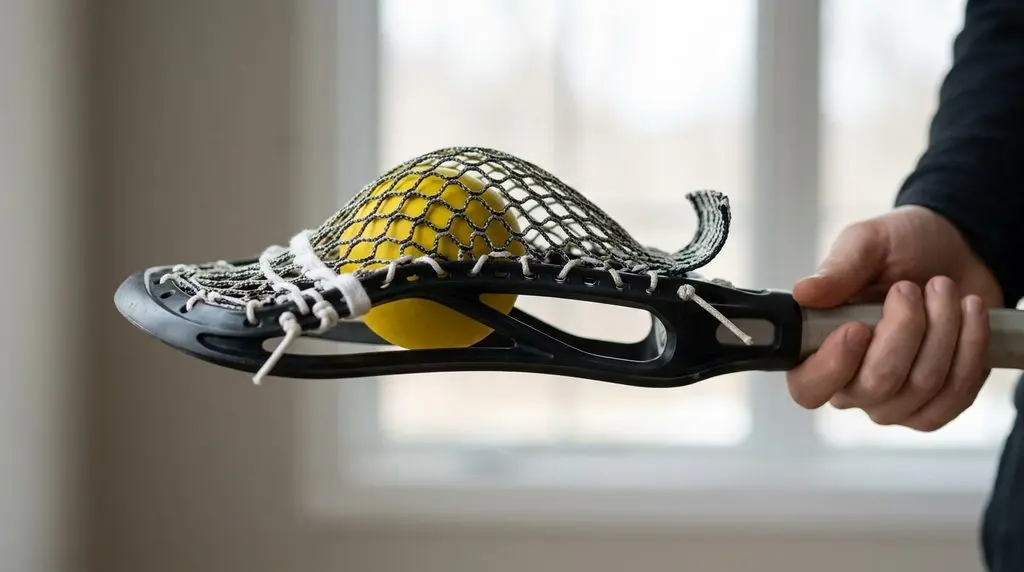
Hold the stick horizontally at eye level with a ball sitting in the deepest part of the pocket. Look along the sidewall.
The NCAA men’s rules interpretation puts the penalty in exactly these terms: if one can see daylight between the top of the ball and the bottom edge of the sidewall, this is an illegal deep pocket. The document specifies a one-minute foul on the offending player, with the crosse allowed to return once corrected.
So in the men’s game the sidewall must obstruct your view of at least part of the ball. If the ball has dropped so far that there’s a clear gap of light between the top of it and the bottom edge of the sidewall, the pocket is too deep.
Practically: you should not be able to see over the top of the ball, under the sidewall. If you can, it needs tightening.
The women’s test
Now flip it.
In the women’s game, the top of the ball — when the stick is held horizontally with a ball in the pocket — must be visible above the top of the entire sidewall. Apply reasonable pressure to the ball with one hand, simulating catching a pass, release it, and the top of the ball must still be visible above the sidewall from both the front and the back of the pocket.
Women’s pockets are therefore much shallower by design. That isn’t a stylistic preference, it’s the rule, and it’s why a men’s stick is simply not usable in a women’s game.
Youth girls’ rules allow a modified pocket at younger levels that’s more lenient than the full women’s standard. Check the specific requirement for your child’s level rather than assuming the 12U and 14U test applies all the way down.
The two tests side by side
| Men’s | Women’s | |
|---|---|---|
| What you look at | Bottom edge of the sidewall | Top edge of the sidewall |
| Pass condition | Sidewall blocks part of the ball from view | Top of ball stays visible above sidewall |
| Fail condition | Daylight between top of ball and bottom of sidewall | Ball drops below the top of the sidewall |
| Result of failing | Deep pocket penalty; stick returns once corrected | Illegal stick |
| Pocket depth | Deeper | Shallower |
If you remember one thing: men’s looks at the bottom of the sidewall, women’s looks at the top.
The other checks worth doing at the same time
While the stick is in your hand.
Does the ball fall out when the head is turned upside down? In the women’s game the ball must move freely in the head and fall out easily when inverted. A ball that has to be shaken loose is a pocket that’s holding too much.
Are the shooting strings where they should be? Women’s rules place shooting strings within the top portion of the head. This is a common failure point on a stick that’s been restrung by an enthusiastic teammate.
Any gaps in the stringing? No hole or gap in the stringing should be large enough to matter. A blown-out sidewall string is both a legality problem and a stick about to fail mid-game.
Has it changed since last season? This is the real one. Mesh stretches. A pocket that was legal in May has had a summer of humidity, wall ball and getting stood on. The pocket didn’t get illegal on purpose — it got illegal by being used.
When to check
Three moments, and the last one is the one people skip.
Before tryouts. An illegal stick at tryouts isn’t a penalty, it’s an impression. Getting sent off to fix your pocket in front of a coach evaluating sixty kids is an avoidable start. The rest of the tryout picture is covered in the tryout preparation guide.
Before the first game of the season. After the whole preseason has stretched everything.
After any period of heavy wall ball. This is the counter-intuitive one. Doing the right thing — high-volume wall ball work — is exactly what deepens a pocket fastest. A player who has put in 400 reps a day all summer is the most likely player on the roster to fail a stick check, precisely because they did the work.
What you need to run the test
A stick and a ball. That’s the whole equipment list, and it’s the one place this actually intersects with buying anything.
Use a real, certified ball, not a tennis ball or a soft training ball. The test is a geometry check against a regulation ball’s diameter, so a ball of the wrong size gives you a meaningless answer. If your household’s lacrosse balls have all vanished into the hedge, that’s the cheapest possible thing to fix before tryout week.
Fixing a pocket that fails
Two honest sentences here, because this is where a lot of articles start inventing.
If the pocket is slightly too deep in the men’s game, tightening the sidewall strings and the bottom string usually brings it back. If it’s badly out, or if the mesh is genuinely worn, it needs restringing by someone who knows what they’re doing — most local lacrosse shops will do it, and plenty of teams have a parent or player who strings well.
What you should not do is discover this in the parking lot before a game. Check it at home, where a fix is a five-minute job instead of a penalty.
Bottom line
Men’s: hold the stick horizontally with a ball in the pocket and look at the bottom edge of the sidewall — if you can see daylight between the top of the ball and that edge, the pocket is illegal. Women’s: look at the top edge instead, and the top of the ball must stay visible above it even after you press down and release. Check before tryouts, before the first game, and after any stretch of heavy wall ball, because doing the reps is what deepens the pocket in the first place.
A Word on Gladiator Lacrosse
Gladiator Lacrosse was founded in 2012 by Rachel Zietz, then a 13-year-old player in Boca Raton whose coaches told her to play wall ball as much as possible — which is the same practice that will eventually stretch your pocket out of legality.
Gladiator doesn’t make sticks or mesh, so there’s no stringing product to sell you here. What it does make is the equipment that puts reps in: lacrosse balls that meet NOCSAE standards and carry SEI certification, official-size goals, and shooting targets for the work you do once the stick passes inspection.
You Might Also Like
- Getting ready for lacrosse tryouts — including when tryouts actually happen
- How many wall ball reps to do — the work that stretches a pocket
- What certified balls actually are — use a real one for the test
FAQ
How do I know if my lacrosse pocket is legal? Hold the stick horizontally at eye level with a ball in the deepest part of the pocket. In the men’s game, if you can see daylight between the top of the ball and the bottom edge of the sidewall, the pocket is too deep. In the women’s game, the top of the ball must stay visible above the top of the sidewall.
Why are men’s and women’s pocket rules different? They’re effectively inverted. Men’s rules measure against the bottom edge of the sidewall and permit a deeper pocket; women’s rules measure against the top edge and require a much shallower one. This is one reason a men’s stick can’t be used in a women’s game.
What happens if you get caught with an illegal pocket? In the men’s game, the NCAA rules interpretation describes a one-minute foul on the player for an illegal deep pocket, with the crosse permitted to return once it has been corrected. Specific penalties vary by rule set and level, so check your own league.
Does a lacrosse pocket get deeper over time? Yes. Mesh stretches with use, moisture and heat, so a pocket that passed in spring can fail by late summer. Players who do the most wall ball tend to stretch their pockets fastest, which means the hardest workers are often the ones who fail a stick check.
Can I fix an illegal pocket myself? If it’s slightly too deep, tightening the sidewall and bottom strings often brings it back into legality. If the mesh is badly stretched or worn, it needs restringing — most lacrosse shops offer this, and it’s far better done at home than discovered at a game.