
The One Position Where the Rulebook Tells You Exactly What to Buy
Most lacrosse equipment decisions are preference dressed up as necessity. Goalie equipment isn’t. Somebody steps into the crease for the first time, usually because nobody else volunteered, and the parent discovers there’s a list — and that parts of the list are written into the rules with standards numbers attached.
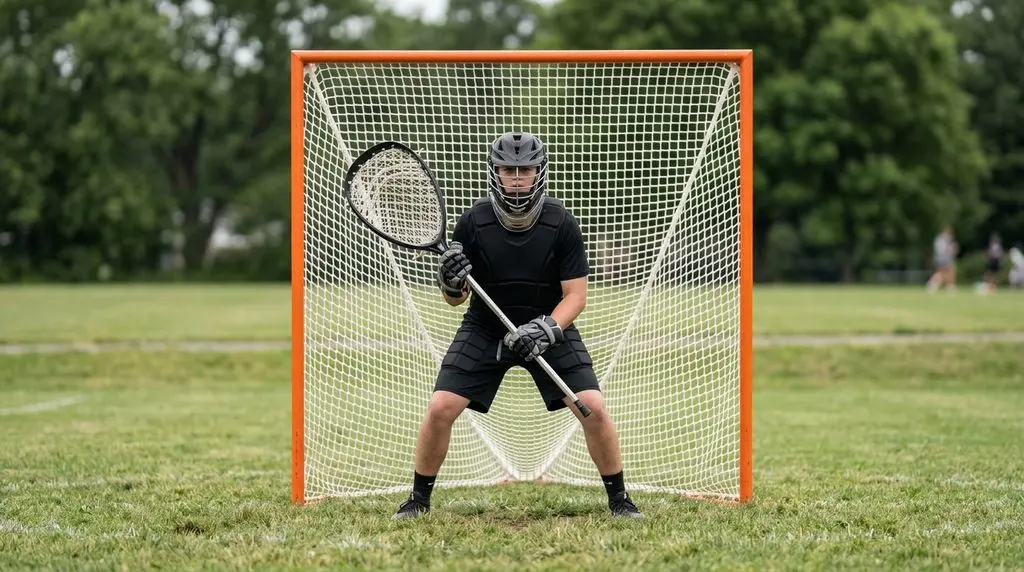
Lacrosse goalie equipment required at every level includes a certified helmet with face mask, a separate throat protector, a chest protector meeting the NOCSAE ND200 standard, padded gloves, a mouthguard and a goalie stick. The chest protector requirement has been mandatory since January 1, 2021 across USA Lacrosse youth rules, NFHS high school rules and NCAA rules, in both the boys’ and girls’ games.
That’s the short answer. The longer answer is that one item on the list exists because of a specific medical risk, and it’s worth understanding before you shop on price.
The required list
Per USA Lacrosse’s own equipment guidance, goalkeepers in both the boys’ and girls’ games wear specialised equipment including a helmet, throat protector, chest protector and padded gloves.
Broken out properly:
| Item | Boys’ goalie | Girls’ goalie | Standard |
|---|---|---|---|
| Helmet with face mask | Required | Required | NOCSAE lacrosse helmet standard |
| Separate throat protector | Required | Required | Attached per manufacturer hardware |
| Chest protector | Required | Required | NOCSAE ND200 |
| Padded gloves | Required | Required | — |
| Mouthguard | Required | Required | — |
| Protective cup / pelvic protector | Required | Required | — |
| Goalie stick | Required | Required | Length varies by age bracket |
| Shin and thigh padding | Commonly worn | Required at youth level | — |
The throat protector is the item people try to skip because it looks like an accessory. It isn’t optional, and it’s separate from the helmet — a unit attached to the helmet using the manufacturer’s own hardware. A goalie takes direct shots to the throat area at a frequency no field player does, which is exactly why the rules single it out.
What ND200 actually is, and why it’s not negotiable
This is the part worth reading even if you skim everything else.
NOCSAE ND200 is the first performance standard written for chest protection in lacrosse. Per USA Lacrosse, compliance with it reduces impact forces and therefore the risk of commotio cordis — cardiac arrest caused by a blow to the area over the heart. That is the specific hazard the standard exists to address.
The mandate dates:
- January 1, 2021 — goalie chest protectors, in USA Lacrosse boys’ and girls’ youth rules, NFHS boys’ and girls’ high school rules, and NCAA men’s and women’s rules
- January 1, 2022 — shoulder pads for boys’ and men’s field players must also be designed for lacrosse and meet ND200
And a detail that decides whether a product you already own is legal: all chest protectors and shoulder pads must carry the NOCSAE logo and the SEI certification mark on both the packaging and the product itself to be legal for play.
So a hand-me-down chest protector with no visible NOCSAE logo on the product is not a bargain. It’s a piece of equipment that will fail an equipment check and, more to the point, wasn’t built to the standard that exists to protect a specific part of a child’s chest.
This is the same certification architecture that governs balls — NOCSAE writes the performance standard, SEI independently tests and certifies against it. If that relationship is new to you, the ball certification guide explains it properly.
Boys’ versus girls’: same crease, different game around it
The two games differ enormously for field players and barely at all for goalies.
Girls’ field players need very little: a stick, a mouthguard and protective eyewear are the only required items for most players, with headgear and close-fitting gloves optional. Boys’ field players carry a full kit — helmet, gloves, shoulder pads, arm pads, mouthguard and a protective cup, with rib pads optional.
But both goalies wear helmet, throat protector, ND200 chest protector and padded gloves. Girls’ youth goalies additionally wear pelvic, shin and thigh padding.
The practical consequence for a household: a girls’ field player’s kit is genuinely inexpensive, and a girls’ goalie’s kit is not. That’s a surprise for a lot of families and it’s better to know it before your daughter volunteers.
What’s genuinely optional
Not everything sold for goalies is required.
Rib pads are optional for boys’ field players and commonly worn by goalies who’ve taken one in the ribs.
Goalie pants and padded shorts are widely used and not universally mandated at every level — check your own league.
A backup stick isn’t equipment, it’s insurance, and any goalie who has had a shaft snap mid-game buys one afterwards.
What is not optional, at any level, under any rule set: helmet, throat protector, ND200 chest protector, gloves, mouthguard, cup.
The equipment that makes a goalie better
Protective gear keeps them safe. It doesn’t make them good. Reps do that, and goalie reps are harder to come by than field-player reps because a goalie needs someone shooting.
Three things that actually help:
Shots at a real goal. A goalie who trains in a 6×6 develops accurate positioning and angles. A goalie who trains on a smaller cage learns angles that don’t transfer. This is the strongest argument for a proper official-size goal at home — the goalie is the player who benefits most from correct dimensions, because their entire job is geometry.
A lot of balls. A shooter with six balls spends most of the session walking. A shooter with twenty-four keeps the goalie working. Volume of balls is the cheapest way to raise the intensity of a goalie session.
Shooters with a reason to aim. Corner-focused shooting produces the saves goalies actually need to practise. A shooting target gives the shooter a spot to hit, which turns aimless shooting into repeatable work on specific save positions.
Buying order, if you’re starting from zero
- Helmet and throat protector — the two non-negotiables, fitted properly
- ND200 chest protector, logo and SEI mark visible on the product
- Padded gloves and a mouthguard
- Cup or pelvic protector
- Goalie stick sized to the bracket
- Then, and only then, the training equipment that generates reps
Fit matters as much as the item. USA Lacrosse’s guidance on helmets is that it should sit level on the head, about one finger-width above the eyebrows. A correctly certified helmet worn badly is not doing its job.
Bottom line
Helmet, separate throat protector, ND200 chest protector, padded gloves, mouthguard, cup and a goalie stick — required at every level, in both the boys’ and girls’ games, since the ND200 goalie mandate took effect on January 1, 2021. Check for the NOCSAE logo and SEI mark on the product itself before you buy anything second-hand. After that, what improves a goalie is shots at a correctly sized cage and enough balls to keep them coming.
A Word on Gladiator Lacrosse
Gladiator Lacrosse doesn’t make goalie protective equipment — helmets, chest protectors and throat guards come from the specialists who certify them, and that’s how it should be.
What the company has made since Rachel Zietz founded it in 2012 is the equipment on the other end of the shot. The Gladiator Lacrosse® Official Lacrosse Goal with 6mm Net is official 72″ x 72″ on an all-steel frame, which is the cage a goalie should be learning angles in. The lacrosse balls meet NOCSAE standards and are SEI certified, and come in boxes of twelve and cases of 120 — because the limiting factor in a goalie session is almost never the goalie.
You Might Also Like
- What size goal you need — the dimensions a goalie’s angles depend on
- What NOCSAE certification actually means — the same standards body behind ND200
- Choosing a shooting target — to give your shooters something to aim at
FAQ
What equipment is required for a lacrosse goalie? A certified helmet with face mask, a separate throat protector, a chest protector meeting NOCSAE ND200, padded gloves, a mouthguard, a protective cup or pelvic protector and a goalie stick. Girls’ youth goalies additionally wear pelvic, shin and thigh padding.
What is NOCSAE ND200? ND200 is the performance standard for lacrosse chest protection. According to USA Lacrosse, compliance reduces impact forces and therefore the risk of commotio cordis — cardiac arrest caused by a blow over the heart. It became mandatory for goalie chest protectors on January 1, 2021.
Do lacrosse goalies need a throat protector? Yes, at every level, in both the boys’ and girls’ games. It’s a separate unit attached to the helmet using the manufacturer’s hardware, not part of the helmet itself, and it’s required because goalies take direct shots toward the throat far more often than field players.
Can my child use a second-hand goalie chest protector? Only if it carries both the NOCSAE logo and the SEI certification mark on the product itself. Chest protectors made before the ND200 standard took effect are not legal for play, and the marks must appear on the product and the packaging.
Is goalie equipment different for girls’ lacrosse? The core requirements are the same — helmet with face mask, separate throat protector, ND200 chest protector and padded gloves. Girls’ youth goalies also wear pelvic, shin and thigh padding. The difference is much larger for field players, where girls need only a stick, mouthguard and eyewear.