
The Net Doesn’t Fail All at Once, Which Is Exactly the Problem
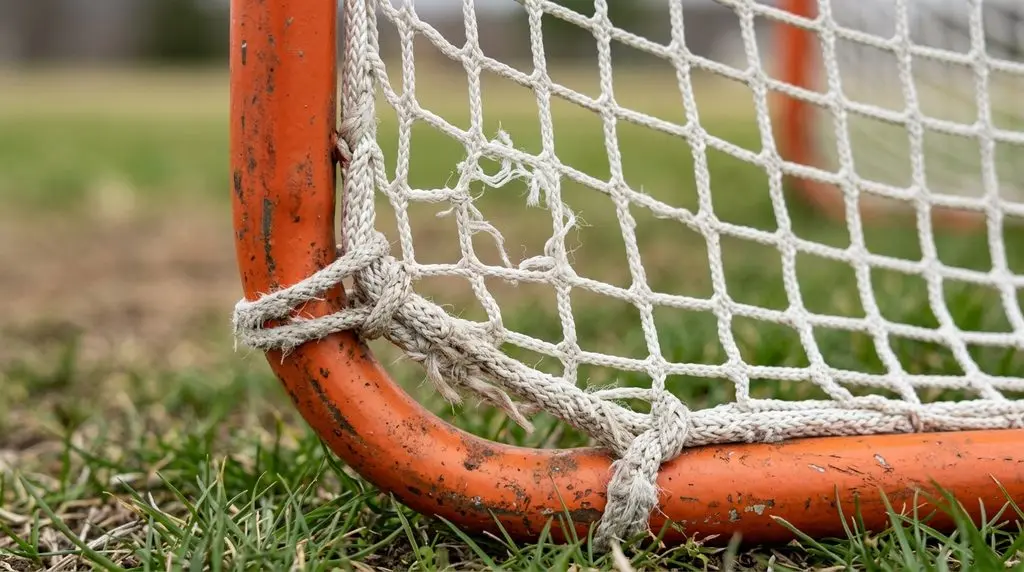
A goal net rarely dies dramatically. It frays where the lacing rubs, opens a small hole low in a corner, and carries on looking broadly fine for another season while balls quietly trickle out the bottom during practice and nobody can agree whether that counted.
Lacrosse net repair is worth doing when the damage is localised — a single broken strand, a frayed section of lacing, a few inches of separation along an edge. Replacement is the answer when the mesh has gone brittle and breaks in new places each time you fix one, or when a hole is large enough for a ball to pass through, because at that point the net no longer does its one job.
There’s no official replacement schedule to appeal to here. Nobody publishes one — which is why this is an inspection, not a calendar.
The one hard standard that exists
Start with what the rules actually require, because it gives you a pass/fail line rather than a judgement call.
The net must be fastened to the goal posts, crossbar and ground so that the ball cannot pass through. The NCAA women’s rulebook adds it explicitly: no hole or gap may be large enough to pass a ball. The rules also cap mesh openings at an inch and a half.
So the test isn’t “does it look tired.” It’s: can a ball get through anywhere it shouldn’t? Through a hole, through a gap at the base, through a separation where the lacing has failed along the pipe. If yes, the net is failing its function regardless of how much life is left in the rest of it.
The ten-minute inspection
Do this at the end of a season and again before the first practice. Bring a ball.
1. The bottom edge and the ground line. Where nearly all real failures happen. Balls hit low, the net drags, and the lacing at ground level takes the most abrasion. Run your hand along it and look for separation between net and frame.
2. The corners. Second most common failure point, especially on a goal that gets assembled and disassembled seasonally. Look for strands that have pulled out of shape rather than broken.
3. The lacing cord itself. Often the actual culprit when a net “fails”. The mesh is fine; the cord holding it to the pipe has frayed through at a rub point. This is the single most repairable problem there is, and replacement lacing cord fixes it for a fraction of the price of a new net.
4. Brittleness. The real verdict. Take a strand between two fingers and flex it. Supple means life left. Stiff, chalky, or snapping under light pressure means UV has done its work and the whole net is near the end — fixing one hole in a brittle net just relocates the problem.
5. The ball test. Push a ball firmly against any suspect hole. If it goes through, or nearly does, that area needs fixing before the next session.
Repair or replace
| What you’re looking at | Verdict |
|---|---|
| Frayed or broken lacing cord, mesh intact | Repair — re-lace that section |
| One or two broken strands, rest supple | Repair — tie off and close the gap |
| Separation along the bottom edge | Repair — re-fasten, check the ground line |
| Hole a ball can pass through, rest of net healthy | Repair if localised, watch closely |
| Mesh stiff, chalky, snapping in new places | Replace — it’s UV-degraded throughout |
| Multiple holes across different panels | Replace — you’ll be repairing weekly |
| Net no longer holds shape under shots | Replace |
The pattern worth internalising: one problem in a healthy net is a repair; the same problem appearing repeatedly is a replacement. If you fixed a hole last month and there’s a new one somewhere else this month, stop fixing and start shopping.
How to actually repair one
For a broken strand or small hole, you’re closing the gap so a ball can’t pass, not restoring the net to factory condition.
Use a strong synthetic twine or spare lacing cord rather than household string — it needs to survive the same UV and shot impact everything else does. Work from the sound mesh on either side of the damage, pull the edges of the hole together, and tie off securely with the knot on the outside of the net where it won’t catch a ball. Keep the repaired openings roughly consistent with the surrounding mesh rather than cinching them shut into a stiff lump.
For failed lacing, re-lace that section properly rather than patching over it. The method is the same one used to install a net in the first place, which is covered step by step in the net lacing guide.
What actually kills nets
Not shots. Nets absorb shots remarkably well — that’s what they’re for.
UV. The main killer, and the reason a net that lives outside year-round fails years earlier than one that comes in. Sunlight breaks down polyester over time and the failure mode is exactly that brittleness test above.
Standing water and ice. A net left down through winter holds water, freezes, and the weight tears at fastening points.
Abrasion at rub points. Wherever net meets frame and moves in the wind, something eventually wears through — usually the cord.
Being left up all off-season. The one you control completely. Taking the net off is the single highest-value maintenance habit there is, and the goal maintenance and off-season storage guide covers the rest of it.
If you are replacing
Two things decide which net you need, and neither is price.
Frame shape. Round-corner frames and welded square-corner frames take differently cut nets, and some nets are sold as universal to fit either. Match the net to the shape of your frame. Gladiator’s FAQ page covers fit questions, and if your goal’s corner style isn’t obvious, look at the top corners — a curve means round, a sharp welded right angle means square.
Thickness, which is a durability decision rather than a compliance one. The rules cap mesh opening size and require the net be fastened so a ball can’t pass; they don’t specify twine thickness. Heavier twine survives sun and shots longer. A net that lives outside all year in strong sun has a much stronger case for going thicker than one that comes in every November.
The replacement net range runs from 5.0 mm through 7.0 mm, in round-corner, square-corner and universal cuts, including a Velcro-attached version that’s considerably faster to fit than lace-on if you take your net off seasonally.
Bottom line
Inspect rather than schedule, because no governing body or manufacturer publishes a replacement interval. Check the bottom edge, the corners and the lacing, then flex a strand: supple mesh with localised damage is a repair, brittle mesh that keeps failing in new places is a replacement. The pass/fail line is whether a ball can get through somewhere it shouldn’t. And the thing that decides how long the next net lasts is whether it spends the off-season on the frame or in a bag.
A Word on Gladiator Lacrosse
Rachel Zietz started Gladiator Lacrosse in 2012, aged 13, because the backyard gear available to her didn’t survive being left outside. Nets were a large part of that frustration, and they’re still the part of a goal that decides whether it lasts.
The replacement net range covers 5.0 mm through 7.0 mm in square polyester netting, in round-corner, square-corner and universal-fit versions, with the heavier options carrying a UV and weather-resistant coating for goals that live outdoors year round. Goal lacing cord is sold separately, which matters more than it sounds — a lot of “dead” nets are really just dead cord.
You Might Also Like
- How to lace a net onto a goal — the same method you’ll use for a re-lace
- Goal maintenance and off-season storage — what actually extends a net’s life
- What size goal you need — before you order a net that doesn’t fit
FAQ
Can you repair a hole in a lacrosse net? Yes, if the damage is localised and the surrounding mesh is still supple. Use strong synthetic twine or spare lacing cord, pull the edges of the hole together from the sound mesh either side, and tie off with the knot on the outside. If the mesh is brittle and breaking in new places, replace the net instead.
How often should you replace a lacrosse net? There’s no published replacement interval from any governing body or manufacturer, so replace based on inspection rather than a schedule. The practical test is whether a ball can pass through a hole or gap, and whether the mesh still flexes without snapping.
What makes a lacrosse net fail? UV exposure is the main cause — sunlight degrades polyester until strands go brittle and snap. Standing water and ice over winter, plus abrasion where the net rubs against the frame, do the rest. Shots themselves cause surprisingly little damage.
Do the rules say anything about holes in a lacrosse net? Yes. The net must be fastened to the posts, crossbar and ground so the ball cannot pass through, and the NCAA women’s rulebook specifies that no hole or gap may be large enough to pass a ball. Mesh openings are also capped at an inch and a half.
How do I know which replacement net fits my goal? Match the net to the shape of your frame: curved top corners need a round-corner net, sharp welded right angles need a square-corner net, and some nets are sold as universal to fit either. Check the fit guidance on the product page before ordering.