
The Two Specs That Decide Whether a Ball Bag Survives
Everyone shops for these the same way. You look at the capacity number, pick the biggest one in budget, and move on. Then six months later the zipper has given up or the bottom seam has gone, and a hundred rubber balls are on the floor of the garage.
A lacrosse ball bag is judged on capacity, but it survives or fails on two other things: the zipper and the base. Capacity tells you how many balls fit. The zipper and the base decide whether the bag still works after a season of being dragged across a field with 30 pounds of rubber in it. Buy on all three.
Here’s how to read the numbers, including one thing about capacity that nobody in this category admits.
What capacity actually means, and the trap in it
Capacity is the marketed spec across the whole category. Competing bags advertise 60, 72, 75. Gladiator’s ball bag holds up to 100.
Here’s the awkward part, and it applies to us as much as anyone. Bag capacities and ball pack sizes don’t line up. Gladiator sells a bag rated to 100 balls and a case of 120. Buy one of each, which is a completely reasonable thing for a coach to do, and twenty balls have nowhere to live.
Nobody in this category mentions that, because the bag and the case are usually sold by different brands. But the buyer hits it on day one, so it’s worth saying: check your bag capacity against the pack size you’re actually buying, not against a number in the abstract. If you’re buying a case, plan on two bags or on leaving a reserve in the box.
The practical version for most people:
| What you’re buying balls by | Realistic bag need |
|---|---|
| Singles and 3-packs | No bag needed yet |
| A 6-pack or two | A bag is a nice-to-have; a pocket works |
| A box of 12 | One bag, comfortably |
| Several boxes | One bag covers it |
| A case of 120 | More than one bag, or a bag plus the box as storage |
Why the zipper and the base decide everything
A full bag is heavy in a way people underestimate. A hundred lacrosse balls at roughly five ounces each is around thirty pounds of hard rubber with no give in it, and it all settles to the bottom.
That load does two things. It hangs on the zipper every time you pick the bag up half-open, and it grinds against the base every time the bag gets dragged rather than carried. Which is every time, because nobody carries a full ball bag with good posture.
So the two specs worth checking:
A tough zipper. This is the failure point on cheap bags and it’s terminal, because a ball bag that won’t close isn’t a ball bag. Gladiator’s spec calls this out directly, and it should.
A fortified base. The bottom takes all the weight and all the abrasion. A reinforced base is the difference between a bag that lasts several seasons and one that splits along the bottom seam in the first year.
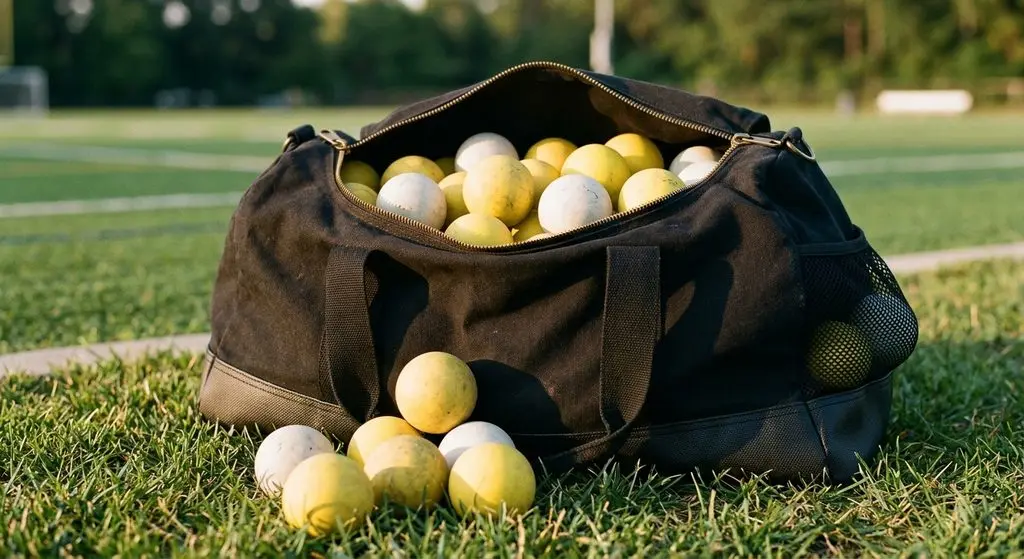
The Gladiator bag is 17 by 10 by 10 inches and weighs 3 pounds empty, with a mesh side pocket for keys and a phone. That last one sounds like a throwaway feature until you’re a coach with no pockets running a practice.
How many balls you’re actually carrying
Worth grounding this in the real numbers rather than guessing at capacity.
The NCAA men’s rulebook requires a minimum of six and a maximum of ten balls available at each end line and each sideline, supplied by the home team, with an equal number in each area. That’s four areas, so 24 balls on the sidelines is the floor just to host a game. Before practice stock, before the ones lost in the tree line.
USA Lacrosse’s practice materials work in ratios rather than counts: partner drills specify one ball per pair, which makes roster-divided-by-two a sensible practice floor.
Put those together and the shape of a real inventory appears. A program is carrying dozens of balls, not a handful, and the bag is the thing that makes moving them survivable. An individual player past their first season is usually in box-of-12 territory, and the bag matters less until they aren’t.
Gladiator’s ball lineup runs from singles up to cases of 120, all 100% premium vulcanized rubber, meeting NOCSAE standards and SEI certified.
What a lacrosse ball bag does that a bucket doesn’t
Buckets are the obvious alternative and they’re genuinely fine for some situations, so here’s the honest comparison.
A bucket stands up on its own, which is useful on a sideline, and you can reach into it without unzipping anything. It’s also rigid, awkward to carry any distance, and it doesn’t fit in a car boot alongside anything else.
A bag carries over a shoulder, packs down when it’s empty, and squashes into a car with the rest of the gear. It doesn’t stand open by itself, which is the trade.
For a coach moving equipment from a car to a field and back twice a week, the bag wins. For a fixed setup where the balls live in one place, a bucket is fine and cheaper.
One thing a bag does that nothing else does: it keeps the practice balls together and separate from the game balls. Which matters, because worn balls go slick and slick balls change how a shot releases. The practice balls guide covers when to retire one.
Using a lacrosse ball bag for storage, not just transport
The part most guides skip.
Balls left loose in a garage pick up grit, and grit is abrasive against mesh. It wears a pocket faster than the player does. Balls left outside in a bucket sit in whatever rain collects. Neither is dramatic, but both shorten the life of things that cost more than the balls.
The realistic habit: balls go back in the bag, the bag comes inside, and once a season you tip the whole lot out and bin the ones that have gone slick. Takes five minutes and it’s the difference between a bag of usable balls and a bag you have to sort through every session.
Bottom line
Buy on capacity, zipper and base rather than capacity alone, because the zipper and base are what fail. Check the bag’s capacity against the pack size you’re actually ordering, since a case of 120 doesn’t fit a 100-ball bag. And use it for storage as well as transport, because loose balls pick up grit and grit wears out mesh.
A Word on Gladiator Lacrosse
Gladiator Lacrosse was founded in 2012 by Rachel Zietz, a 13-year-old player in Boca Raton whose equipment kept failing before she was done with it. The catalogue is lacrosse-only: official-size steel-framed goals, replacement nets in four twine thicknesses, shooting targets, rebounders, and balls.
The Gladiator Lacrosse® Ball Bag holds up to 100 balls at 17 by 10 by 10 inches, with a tough zipper, a fortified base and a mesh side pocket. It pairs with the ball lineup, which runs from singles through boxes to cases of 120, all meeting NOCSAE standards and SEI certified.
You Might Also Like
- Lacrosse balls — singles through cases, plus soft training balls
- Practice balls vs game balls — what goes in the bag and what comes out of it
- What a NOCSAE certified lacrosse ball means — the marking and the standard behind it
FAQ
How many balls should a lacrosse ball bag hold? Match it to the pack size you actually buy rather than to a number in the abstract. A box of 12 fits any bag comfortably; a case of 120 will not fit a 100-capacity bag, so plan on two bags or on leaving a reserve in the box. Gladiator’s ball bag holds up to 100 balls.
What should you look for in a lacrosse ball bag? Three things: capacity, the zipper and the base. Capacity gets all the marketing attention, but the zipper and the base are what fail. A hundred balls is roughly thirty pounds of hard rubber that settles to the bottom and hangs on the zipper, so a tough zipper and a fortified base decide whether the bag lasts more than a season.
Is a lacrosse ball bag better than a bucket? For moving balls it is. A bag carries over a shoulder, packs flat when empty and fits in a car with the rest of the gear. A bucket stands open on a sideline and needs no unzipping, which is genuinely useful for a fixed setup. Coaches transporting equipment usually prefer the bag.
How heavy is a full lacrosse ball bag? Heavier than people expect. A lacrosse ball is around five ounces, so a hundred of them is roughly thirty pounds of hard rubber with no give in it, plus the bag itself. That weight is why the base and zipper specs matter, and why bags get dragged rather than carried.
How should you store lacrosse balls between practices? In the bag, and bring the bag inside. Balls left loose in a garage pick up grit, which is abrasive against stick mesh and wears out a pocket faster than play does. Once a season, tip the lot out and retire any that have gone slick, since a worn ball changes how a shot releases.