
Most Rebounder Buying Advice Lists Features You Don’t Need
Search for how to choose a lacrosse rebounder and you’ll get a list of specifications: adjustable tension, target markings, frame material, net tightness. It reads authoritative. It also skips every question an actual buyer asks out loud, which is usually some version of how loud is this thing, can I leave it out, and will my kid use it.
The features that actually decide whether a rebounder works for you are rebound angle adjustment, the type of rebound surface, the assembled footprint, how it stores, and how much noise it makes in a small yard. Frame material matters mainly as a proxy for weight and stability. Target markings, tension dials and net tightness matter far less than the internet suggests, because most rebound surfaces are a fixed panel rather than an adjustable net.
Here’s the version organized around what you’ll actually notice after it’s in the yard.
The criteria that genuinely change your experience
| What to look at | Why it matters | What to look for |
|---|---|---|
| Rebound angle adjustment | This is the single biggest functional difference between units. Angle determines whether the ball comes back at your feet, your chest, or above your shoulder | Multiple set positions, not just one fixed angle. Low returns train ground balls, high returns train catches above the shoulder |
| Rebound surface type | Solid panel and open mesh behave differently. A solid dampened panel gives a consistent, quieter return; loose mesh is livelier and noisier | Know which you’re buying. It’s often not stated clearly |
| Assembled footprint | The number that surprises people. It’s not just the panel, it’s the leg spread front to back | Check depth, not just height and width, against your actual yard |
| Storage | Determines whether it lives in your yard year-round or goes away in the off-season | Folds flat, and whether one person can move it |
| Noise and dampening | The reason some rebounders get retired after a month in a suburban yard | A dampened surface, if neighbours are close |
| Weight | Governs whether you can reposition it and how stable it is under a hard shot | Heavy enough to stay put, light enough to move with help |
| Replacement parts | Small hardware fails long before the frame does | Whether pins, clips and fasteners are sold separately at all |
Notice what’s not on that list. Tension settings and target markings appear in a lot of buying advice, but plenty of good rebounders have neither, and their absence isn’t a defect. If a guide leads with those, it’s describing one specific product category rather than telling you how to choose.
How loud is it, actually
Nobody writes about this and it’s one of the top reasons a rebounder stops getting used.
A ball hitting a taut surface makes a crack. Do that four hundred times in a session, in a yard where the neighbour’s patio is twenty feet away, and you’ll find out quickly whether your setup is sustainable. A dampened rebound surface absorbs more of that impact and returns the ball more quietly than a drum-tight one.
The Gladiator Lacrosse® Wall Rebounder uses a dampened surface specifically for this, which is what makes it workable in small backyards. If your practice space shares a fence line with someone else’s evening, weight this more heavily than you’re inclined to.
Solid panel or open mesh
Worth understanding because product photos don’t always make it obvious and the two play differently.
A solid panel returns the ball consistently across its face, absorbs more sound, and doesn’t let anything through. A loose mesh or net surface tends to be livelier and louder, and how it plays depends heavily on how tight it’s strung, which changes as it ages.
Gladiator’s rebounder uses a solid taut panel rather than an open net. For a player working on catching rhythm, consistency of return matters more than liveliness, and a panel gives you that.
Can it live outside
Here’s the honest answer rather than the marketing one.
Steel frames handle rain and sun fine. What actually degrades outdoor equipment is standing water at the feet, a full winter under snow, and never being brought in. Fabric and vinyl components are the wear items, not the steel.
The realistic approach: fold it flat and store it under cover through the off-season, keep the feet out of a puddle, and check the hardware each spring. That’s most of the maintenance, and it’s the difference between a rebounder that lasts years and one that looks tired after two.
Worth knowing before you buy: Gladiator’s stated warranty covers manufacturing defects for 90 days from purchase, with the buyer covering shipping on a claim, and it excludes normal wear and tear. Plan on year-two upkeep being your job.
How much space you need
Two numbers, and people usually only check one.
The panel’s height and width tell you what the ball hits. The depth tells you how much yard it actually occupies, because a free-standing rebounder sits on an A-frame that spreads backward. The Gladiator rebounder is 82 inches high, 47 wide, and 55 deep set up, at about 60 pounds. That depth is the number that catches people out.
Then add throwing distance in front. Ten to twelve feet is the standard working distance for throwing and catching reps, closer for quick-stick work. So a usable setup wants roughly the unit’s footprint plus twelve feet of clear ground, and something behind you that isn’t a window.
How fast does the ball come back
Faster than beginners expect. Gladiator states the ball returns at or near the speed it was thrown, which is exactly what makes a rebounder useful for training reaction time, and exactly why a new player shouldn’t start at the highest angle and shortest distance.
Start a younger or newer player at a lower angle and a longer distance, then bring them in as their hands catch up. A rebounder that scares a kid gets abandoned, and that’s a training problem rather than an equipment one.
Assembly, storage, and moving it
At around 60 pounds, this is a two-person job to carry and a one-person job to reposition once it’s built. It folds flat for storage, which is genuinely the feature that determines whether it goes in the garage each winter or stays out and weathers.
Gladiator publishes assembly instructions by product, which is worth a look before you buy if you want to know what you’re getting into.
Small hardware is the thing that actually fails first on any rebounder — pins, clips, fasteners. Gladiator sells rebounder replacement pins and clips separately, which sounds trivial until the alternative is replacing an entire unit because one pin walked off.
Rebounder, wall, or goal — which do you actually need
The question behind the question, and the one most guides skip entirely.
A brick or concrete wall is a fine training surface and it’s free. If you have one that you’re allowed to throw at, use it. The limits: it’s fixed where it is, the rebound angle is whatever the wall gives you, and most people don’t have one. A garage door dents and drywall isn’t a wall.
A rebounder replaces the wall you don’t have. You can set the return angle, put it where you want it, and fold it away. It’s the right buy for a player working on throwing, catching, quick sticks and ground balls, which is the majority of what develops a young player.
A goal is for shooting. It’s a bigger footprint, and it’s the right buy once a player has enough stick control that shooting practice is worth the space. A goal doesn’t return the ball, so a player alone with a goal spends a lot of their session walking.
The honest order for most players: balls first, rebounder second, goal third. Wall work builds the hands, and hands are what everything else is built on. If you’re buying one thing for a player still developing fundamentals, the rebounder does more per dollar and per square foot. You can compare what’s available on the walls and rebounders page, and the goal lineup if shooting is genuinely where the player is.
Bottom line
Judge a rebounder on angle adjustment, surface type, real assembled depth, how it stores, and how loud it is where you live. Ignore feature lists built around tension dials and target markings. And before you buy anything, be honest about whether the player practices on their own already, because a rebounder multiplies an existing habit rather than creating one.
A Word on Gladiator Lacrosse
Gladiator Lacrosse exists because of this exact product. Rachel Zietz founded the company in 2012, at 13, after her coaches told her to play as much wall ball as possible and the backyard rebounders she could find were either priced out of reach or fell apart from living outside. The rebounder is the founding product, not an accessory.
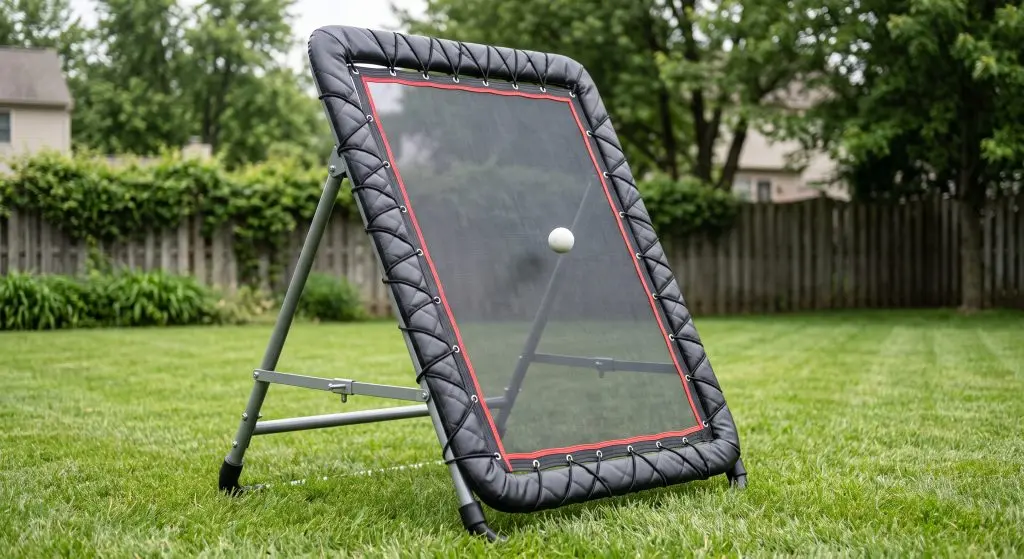
The Gladiator Lacrosse® Wall Rebounder gives a 4′ x 3′ rebound surface on an adjustable steel frame with three rebound angle positions and a dampened panel built for small yards. Assembled it’s 82 inches high, 47 wide and 55 deep at about 60 pounds, and it folds flat between sessions. There’s also a Casey Powell Signature Edition Wall Rebounder in an all-black finish, which ships with a step-by-step training guide credited to Powell.
You Might Also Like
- Walls and rebounders — the full lineup and specs
- Lacrosse goals — if shooting practice is the actual need
- Assembly instructions — setup guides by product
FAQ
What should you look for in a lacrosse rebounder? Rebound angle adjustment, the type of rebound surface, the assembled footprint including depth, whether it folds for storage, and how much noise it makes. Angle adjustment matters most, because it determines whether you’re training ground balls, chest-height catches or high catches. Tension settings and target markings appear in a lot of buying advice but matter far less in practice.
Are lacrosse rebounders worth it? For a player who already practices on their own, yes — a rebounder removes the need for a throwing partner and can add hundreds of reps a week. For a player who only touches a stick at team practice, it’s premature. Equipment multiplies an existing habit rather than creating one, so buy balls first and revisit after a season.
How much space do you need for a lacrosse rebounder? More than the panel size suggests, because a free-standing unit sits on an A-frame that spreads backward. The Gladiator Lacrosse® Wall Rebounder is 82 inches high, 47 wide and 55 deep assembled. Add throwing distance in front, typically 10 to 12 feet for standard reps, and make sure what’s behind you can take a missed ball.
Can you leave a lacrosse rebounder outside? It’s built for outdoor use, but no backyard equipment improves from a winter under snow. Fold it flat and store it under cover in the off-season, keep the feet out of standing water, and check the hardware each spring. Gladiator’s warranty covers manufacturing defects for 90 days and excludes normal wear and tear.
Should I buy a lacrosse rebounder or a goal first? A rebounder, for most developing players. A rebounder returns the ball and trains throwing, catching, quick sticks and ground balls, which is the foundation everything else is built on. A goal is for shooting, takes more space, and doesn’t return the ball, so a player practicing alone with one spends much of the session retrieving. Balls, then rebounder, then goal is the usual order.