
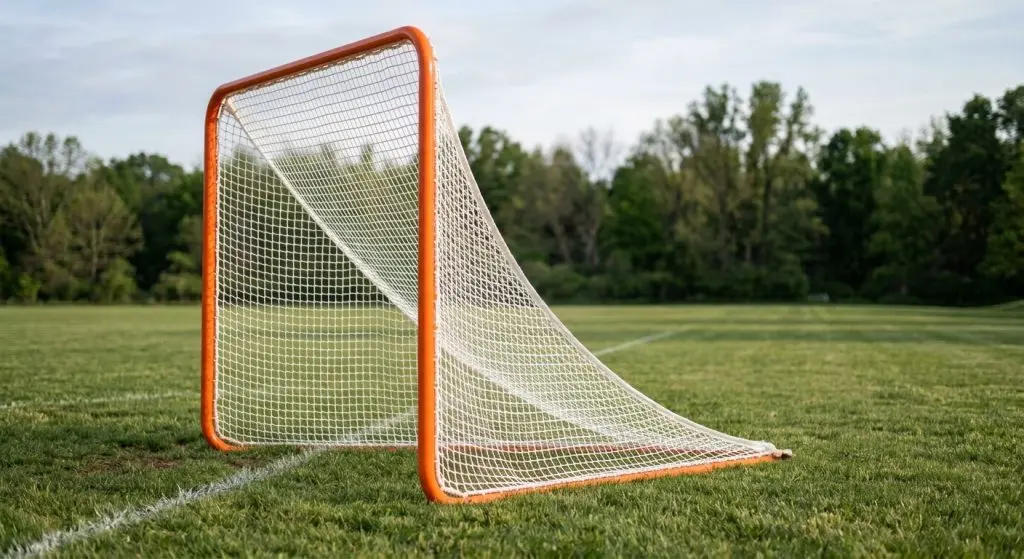
Shop for a goal and you’ll see two formats used interchangeably. Some listings say 6×6. Others say 6x6x7. Nobody explains the difference, so most people assume the third number is how deep the goal is, and buy accordingly.
A regulation lacrosse goal has an opening 6 feet wide by 6 feet high, measured inside the frame. The “7” in 6x6x7 is not the frame’s depth. Under NCAA rules, it’s the distance the netting extends back and is fastened to the ground, measured from the center of the goal line. The rules also cap the net’s mesh openings at 1.5 inches. So 6×6 describes the frame; the 7 describes how far back the net is staked.
That distinction matters more than it sounds, because it changes how much space you actually need behind the goal.
What the rulebook actually specifies
The NCAA men’s rulebook is explicit on all three parts.
The goal forms an opening 6 feet wide and 6 feet high, and those are inside measurements — the space the ball has to get through, not the outside of the pipe. The netting has to extend and be fastened on the ground at a point 7 feet back of the center of the goal. And the mesh of the net must not exceed an inch and a half, with the net fastened to the goal posts, crossbar and ground so the ball can’t pass through.
The NCAA women’s rulebook matches: 6 feet by 6 feet, netting extending 7 feet behind the center of the goal line, mesh not more than 1.5 inches. It adds that nets may be any solid color and that no hole or gap may be large enough to pass a ball.
So there is no separate men’s and women’s regulation goal. A regulation goal is a regulation goal in both games. That’s genuinely useful if you’re buying for a family or a club that runs both.
One thing the rules don’t specify: the thickness of the net’s twine. A 5.0 mm net and a 7.0 mm net are equally legal. Twine gauge is about how long the net survives outdoors, not about eligibility.
What size do youth players actually need
This is where it stops being one answer, and where the boys’ and girls’ games diverge in a way almost nobody writes about.
| Level | Boys | Girls |
|---|---|---|
| 6U / 8U | Small-sided play. A 3’x3′ goal is recommended, but a full high school goal is permitted | 3’x3′ or 4’x4′ |
| 10U | Standard 6×6 | 4’x4′ or full size |
| 12U / 14U | Standard 6×6 | Full size |
| High school and up | 6×6 regulation | 6×6 regulation |
Read that carefully, because the asymmetry is real. The girls’ game has a graduated ladder of goal sizes. The boys’ game essentially doesn’t. USA Lacrosse’s boys youth rules comparison chart has no goal-size row at all; the recommendation for a 3’x3′ goal appears only in the small-sided section for the youngest levels, and even there a full-size goal is allowed.
The practical consequence: a boys’ 10U program is a 6×6 buyer. A girls’ 10U program may not be. If you’re outfitting a young girls’ program, buying full-size goals may be buying the wrong equipment, and that’s worth checking against your league’s current rules before you order.
For a family buying one goal for a kid who’ll grow into the sport, a regulation 6×6 is almost always the right call regardless. Kids grow into a goal; they don’t grow into a 3’x3′.
What a backyard buyer needs versus what a program needs
Both can be regulation size. The difference isn’t the dimensions, it’s what the frame is built to survive.
| Backyard | Program | |
|---|---|---|
| Opening | 6×6 regulation | 6×6 regulation |
| Frame | 1.5 inch steel | 2 inch steel |
| Corners | Rounded | Square welded |
| Assembly | Snap together, no tools | Multi-piece with a manual |
| Moving it | One person | Two people |
| Shipping | Ground | LTL freight, quoted after checkout |
| Sold as | Single | Single or pair |
The Gladiator Lacrosse® Official Lacrosse Goal with 6.0 mm Net is the backyard-tier regulation option: official 72 by 72 inches on a 1.5 inch all-steel frame with a 6.0 mm braided polyester net, rounded corners and snap-together assembly.
The Gladiator Lacrosse® Professional Lacrosse Goal with 6 mm White Net is the program-tier build: 2 inch all-steel pipe, square welded corners with welded lacing bars, six-piece construction, and Gladiator states it meets NCAA and NFHS specifications. It ships freight and is offered as a single or a pair, which is what you need to host a game. The full goal lineup sits between those two points.
If you’re deciding between them: a backyard goal handles a kid shooting in the yard for years. It is not built for a full roster shooting hard at it four days a week, and buying the lighter frame for a program is a false economy.
How much space you actually need
Since the “7” is a net-staking distance from the center of the goal line, plan for the goal plus the net’s run behind it plus somewhere to stand.
Practically: allow about 7 feet of clear ground behind the goal line for the net and its anchoring, and a bit more if you want to be able to walk around it. In front, allow real shooting distance. A player shooting from 10 feet isn’t practicing anything useful, and a ball that misses is going wherever the yard lets it go. Think about what’s directly behind the goal before you site it, because that’s what stops the misses.
Anchoring matters too. The rules require the net be fastened to the ground, and that’s not just a rules technicality. An unanchored net lifts and lets balls through underneath, which turns every practice into an argument about whether that counted.
Bottom line
Regulation is 6 feet by 6 feet, inside measurement, in both the men’s and women’s games. The 7 you see in listings is how far back the net stakes from the center of the goal line, not the goal’s depth. Buy regulation size unless you’re specifically outfitting a young girls’ program, where smaller goals are genuinely specified. And choose the frame gauge based on who’s shooting at it, because that’s the difference that actually matters between a backyard goal and a program goal.
A Word on Gladiator Lacrosse
Gladiator Lacrosse was founded in 2012 by Rachel Zietz, then a 13-year-old player in Boca Raton who couldn’t find backyard equipment that survived being left outside. The catalog is lacrosse-only and covers official-size steel-framed goals, replacement nets in four twine thicknesses, NOCSAE-standard SEI-certified balls, shooting targets and rebounders.
For a backyard, the Gladiator Lacrosse® Official Lacrosse Goal with 6.0 mm Net is a full regulation 72 by 72 inches on a 1.5 inch all-steel frame with snap-together assembly. For schools and clubs, the Gladiator Lacrosse® Professional Lacrosse Goal with 6 mm White Net steps up to 2 inch steel with square welded corners and is available as a pair.
You Might Also Like
- Lacrosse goals — backyard through program-tier, full specs on each
- Replacement nets — twine thicknesses and corner styles explained
- Assembly instructions — setup guides by product
FAQ
What size is a regulation lacrosse goal? Six feet wide by six feet high, measured inside the frame. That’s the same in the NCAA men’s and women’s rulebooks, so there is no separate women’s regulation goal. The rules also require the netting to extend 7 feet back from the center of the goal line and cap the net’s mesh openings at 1.5 inches.
What does 6x6x7 mean on a lacrosse goal? The first two numbers are the goal opening in feet, 6 wide by 6 high. The third is not the frame’s depth, which is where most listings mislead people. Under NCAA rules it’s the distance the netting extends back and is fastened to the ground, measured from the center of the goal line.
What size lacrosse goal do youth players need? It depends on the age and whether it’s the boys’ or girls’ game. Girls’ youth rules use a graduated ladder, roughly 3’x3′ or 4’x4′ at 6U and 8U, 4’x4′ or full size at 10U, and full size from 12U. Boys’ youth rules have no equivalent ladder: a 3’x3′ goal is recommended for small-sided play at the youngest levels but a full-size goal is permitted, and from 10U up it’s standard 6×6.
Are men’s and women’s lacrosse goals the same size? Yes. Both the NCAA men’s and women’s rulebooks specify a 6 foot by 6 foot goal with netting extending 7 feet behind the center of the goal line and mesh not exceeding 1.5 inches. The equipment is shared. Youth girls’ rules are the exception, using smaller goals at the youngest age levels.
How much space do you need behind a lacrosse goal? Allow roughly 7 feet of clear ground behind the goal line for the net to run back and be anchored, plus a little more if you want to walk around it. In front, allow real shooting distance and think about what will stop the shots that miss, because that’s what determines where the goal can safely go.