
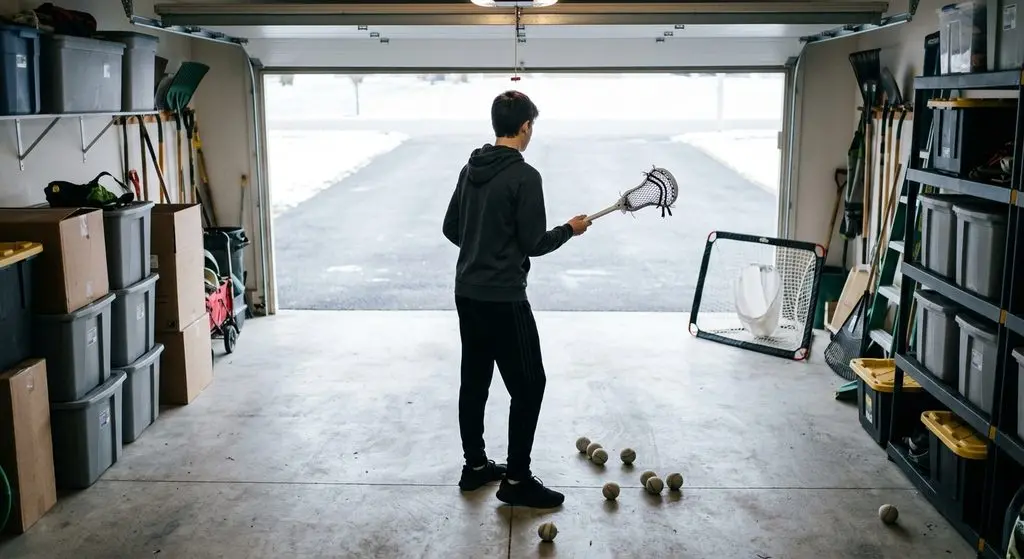
The Ball That Makes Winter Practice Possible Can’t Do Wall Ball
Every indoor training article tells you to keep working on your stick skills through the winter, then describes a session built around throwing at a wall. Which is a problem, because the moment you take a hard rubber ball into a garage you’re choosing between the drywall, the car and the window.
Indoor lacrosse practice works with a soft, non-bouncing ball. And the same property that makes it safe indoors makes wall ball impossible. A ball that doesn’t bounce doesn’t come back off a wall. So an indoor session has to be built around cradling, catching, ground balls and target work instead, and the sessions that try to be wall ball with a soft ball just don’t function.
Once you accept that, the winter actually becomes useful.
What you can and can’t do indoors
Being specific, because generic advice is why people give up on this in week two.
| Skill | Works indoors? | What you need |
|---|---|---|
| Cradling | ✅ Yes, well | Space to walk, a ball that won’t bounce away |
| Catching and quick hands | ✅ Yes | A partner, or a target that returns the ball |
| Ground balls | ✅ Yes, genuinely well | Hard floor, soft ball |
| Stick protection and dodging footwork | ✅ Yes | A few square metres |
| Target work and placement | ✅ Yes | A target with a catching pocket |
| Wall ball | ❌ No | A hard ball, which you can’t use indoors |
| Shooting at pace | ❌ No | Don’t. Just don’t. |
| Long passing | ❌ No | Not enough distance |
Read the two red rows together and the shape of a winter session appears. You’re not going to develop shot power in a basement. You are going to develop hands, and hands are what everything else is built on.
The ball is the whole setup
This is the constraint everything else follows from.
A standard lacrosse ball is solid vulcanised rubber. It bounces hard, it marks surfaces, and it goes through things. Indoors it’s simply not an option, which is why the soft weighted training ball exists.
The Swax Lax Soft Weighted Training Ball that Gladiator stocks is 142 to 149 grams and 64 millimetres across, the same size and weight range as a regulation ball, with a sand-and-rubber fill inside a soft fabric shell rather than solid rubber. It doesn’t bounce, and it’s gentle enough for a hardwood floor.
The weight matching is the part that matters for training quality. A foam ball teaches a player to throw something that doesn’t feel like a lacrosse ball, and those habits don’t transfer. A ball at regulation weight that happens not to bounce trains the real motion.
And then the constraint: it’s suited to a rebounder rather than a wall. No bounce means no return off a flat hard surface. That’s not a defect, it’s the trade that makes indoor practice possible at all.
For the full comparison of ball types and when each is right, the practice balls guide covers it properly.
Setting up the space for indoor lacrosse practice
Four things to sort before the first session, in order of how much trouble they save you.
Pick the floor, not the room. Hardwood, concrete and garage floors all work with a soft ball. Carpet is fine too and slows ground balls down usefully for a beginner. What you’re really choosing is what’s at head height and what’s behind the player.
Clear a lane, not an area. Most indoor work is linear. Cradle down, turn, cradle back. Three or four metres of clear lane beats a wider space with obstacles in it.
Deal with the ceiling before you deal with anything else. Low ceilings rule out overhand throwing motions entirely, which is another reason target work at chest height suits indoor sessions better than anything overhead. Check by having the player go through a throwing motion with an empty stick before a ball appears.
Move the breakable things. A soft ball is soft, not weightless. At regulation weight it’ll still knock a picture off a wall.
Building an indoor lacrosse practice session
A workable 20-minute structure, and the point is that it’s all hands.
Five minutes of cradling. Walking, then changing direction, then with the off hand. Boring, and the most transferable thing on this list.
Five minutes of ground balls. Indoors this is genuinely better than outdoors. A hard flat floor gives a consistent roll, so the technique gets isolated from the terrain. Scoop, run three steps, reset.
Five minutes of catching. With a partner if you have one. Alone, a target with a catching pocket does the job, because the ball stays where you can reach it instead of rolling under the sofa.
Five minutes of placement work. Short, controlled throws at a specific spot. Not shooting. Placement at low pace.
The shooting targets guide covers which target suits which player, and the corner targets are the ones worth knowing about for confined spaces because they’re a two-piece set with a rear pocket that catches the ball rather than letting it go past.
What to skip until spring
Being honest saves people a broken window.
Shooting at pace. There is no indoor space where this is a good idea, and no ball that makes it one. The soft ball reduces damage, it doesn’t eliminate it, and full-pace shooting indoors will eventually find something expensive.
Wall ball. Covered above. A soft ball won’t return, and a hard ball indoors is how you get a new drywall bill.
Anything overhead in a low room. The throwing motion needs clearance that most basements don’t have.
Conditioning work that belongs outside. Winter conditioning is a real thing, but it isn’t stick work and it doesn’t need a ball.
Bottom line
Indoor lacrosse practice is a hands session, not a shooting session, and the ball you need is the one that can’t do wall ball. Get a soft weighted ball at regulation weight, clear a lane rather than a room, check the ceiling before the first throw, and build the session out of cradling, ground balls, catching and low-pace placement. Do that through a winter and the player comes out of it with better hands than the kid who waited for spring.
A Word on Gladiator Lacrosse
Gladiator Lacrosse was founded in 2012 by Rachel Zietz, a 13-year-old player in Boca Raton whose coaches told her to practise as much as she could and whose gear kept failing. Practising in whatever space and season you actually have is close to the founding idea.
The Swax Lax Soft Weighted Training Ball is stocked in singles, three-packs and cases for exactly this problem. Regulation size and weight, no bounce, gentle on a hardwood floor. The shooting targets include a two-piece corner set with rear ball-catching pockets, which is the one that suits a confined space. The rest of the ball range is there for when it’s warm enough to go back outside.
You Might Also Like
- Practice balls vs game balls — which ball for which surface
- Which shooting target you need — including the corner set for tight spaces
- Lacrosse wall ball routine — for when you’re back outside with a hard ball
FAQ
Can you practise lacrosse indoors? Yes, with the right ball and a realistic session plan. Cradling, ground balls, catching and low-pace placement all work well indoors. Shooting at pace and wall ball don’t, regardless of what ball you use. The main constraint is that indoor practice is hands work rather than shooting work.
What ball do you use for indoor lacrosse practice? A soft weighted training ball. The Swax Lax ball Gladiator stocks is 142 to 149 grams and 64 millimetres — the same size and weight range as a regulation ball — but filled with sand and rubber inside a fabric shell, so it doesn’t bounce and is gentle on a hardwood floor. A standard solid rubber ball is not an indoor option.
Can you do wall ball with a soft lacrosse ball? No. A soft training ball doesn’t bounce, which is exactly why it’s safe indoors and exactly why it won’t return off a wall. Wall ball needs a standard hard ball against brick or concrete, which means it’s an outdoor activity. Indoor sessions have to be built around other skills.
How much space do you need to practise lacrosse indoors? Less than people assume, but the right shape. Three or four metres of clear lane is more useful than a wider room with obstacles, since most indoor work is linear. Ceiling height is the real limit. Low ceilings rule out overhand throwing, so check with an empty stick before introducing a ball.
What should a winter indoor lacrosse session look like? Around twenty minutes, all hands: five minutes cradling including the off hand, five minutes of ground balls, five minutes of catching with a partner or a catching target, and five minutes of low-pace placement work. Ground balls in particular are better indoors, because a flat hard floor gives a consistent roll.