
Four Goals, One Photo, Wildly Different Prices
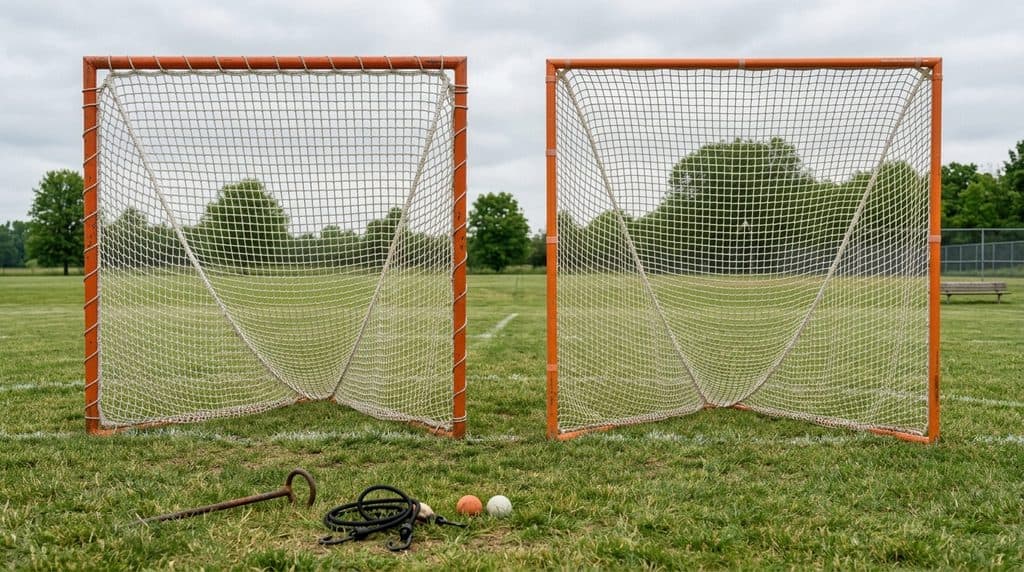
Line up four lacrosse goals in a product grid and they look like the same object. Same six by six opening, same orange pipe, same white net. Then lacrosse goal cost turns out to span a range of roughly ten to one from the cheapest to the dearest, and nothing in the photograph tells you why.
The difference is almost entirely frame: pipe diameter and wall thickness, whether the corners are welded or bolted, and what the metal is finished with. A useful shorthand is shipping weight. A collapsible backyard goal lands around twenty pounds, a fixed practice goal around sixty, and an institutional game goal can exceed a hundred. That weight is the price.
Everything else, net included, is a smaller number than people assume.
What lacrosse goal cost is actually buying
Pipe diameter and wall thickness. The NCAA rulebook specifies goals built from inch-and-a-half metal pipe, which works out to 1.90 inches outside diameter. Cheaper frames use thinner-walled tube at a smaller diameter, and the difference shows up the first time a goal goes over in wind or takes a shoulder. Institutional goals go up to two-inch tube.
Welded versus bolted corners. A consumer goal usually bolts together, which is how it ships flat and how one person assembles it. A game goal is typically mitered and welded, arriving as a rigid structure. Welded corners cannot loosen, which matters when the goal lives on a field and gets moved by whoever is nearest.
Finish. Paint on a steel tube is cosmetic. Galvanizing plus powder coat is a corrosion system, and it’s the single biggest factor in whether a frame is still square in year eight. Goals that live outdoors year round are where this stops being a detail.
Whether a net is included, and which net. This is the one that catches people. “Net included” on a regulation goal can mean a heavy net matched to the frame, or it can mean a thin net that functions as a placeholder. The difference between the lightest and heaviest netting on the market is several times the price, so an included net tells you very little on its own.
| Tier | What you’re getting | Rough shipping weight | Where it makes sense |
|---|---|---|---|
| Collapsible or pop-up | Thin tube, fabric or light net, folds away | Around 20 lb | Small yards, storage constraints, very young players |
| Fixed backyard | Heavier steel, bolted, proper net | 25 to 40 lb | A yard that gets used several times a week |
| Regulation and practice | Full 6x6x7 footprint, real net, built to stay outside | 40 to 60 lb | Serious home training and school practice |
| Institutional and game | Welded, galvanized, powder coated, two-inch tube | 65 lb and up | Programmes, fields, anything officiated |
If you’re still working out which opening size you need before worrying about price, the explainer on what the third number in 6x6x7 means sorts that out first, because buying the wrong size cheaply is still buying the wrong size.
Worth saying plainly: the opening is identical across every one of those tiers. A regulation goal is six feet by six feet whether it cost a little or a lot, and the depth is a separate number again. Nobody is paying more for a bigger target. They’re paying for a frame that’s still rectangular after four winters.
The costs that don’t appear on the product page
Anchoring. This isn’t an accessory, it’s in the rules. The NCAA rulebook requires the net to be fastened to the posts, the crossbar and the ground. Some goals ship with ground anchors and most don’t, and a goal that isn’t anchored is both a safety problem and a ball-under-the-net problem. Budget for it. Goal fastener bungee cords handle the net-to-frame half of that job.
Freight. Large goals frequently carry oversized or freight surcharges that don’t show until checkout, and retailers are generally vague about this in advance. There’s no reliable figure to quote, which is itself the point: check before you order rather than after.
Assembly. A twenty-pound folding goal is a ten-minute job. A hundred-and-eighteen-pound game goal is not a one-person afternoon, and for a programme buying several that’s real labour.
Storage and moving it. Rarely costed, frequently regretted. A welded game goal doesn’t come apart, so it needs somewhere to live and something to move it with. A bolted goal can be broken down, at the price of an afternoon and the slow loosening that comes with repeated assembly.
The net you’ll buy in year three. Which brings us to the argument most buying guides skip.
When a net is the better purchase than a goal
Here’s the thing the tier table above half conceals. On a decent frame, the net is the consumable and the goal is the asset.
The frame is galvanized or powder-coated steel designed to resist weather. The net is the part absorbing every shot, sitting in UV all summer and holding water all winter. Industry figures from netting manufacturers put sports netting service life somewhere in the region of three to ten years depending on material and exposure, and those are general figures rather than lacrosse-specific ones, but the direction is not in doubt. Netting fails in the strike zone, from holes and thinning, which is exactly where lacrosse puts the ball.
So for anyone with a mid-tier goal or better, a tired setup is usually a net problem wearing a goal problem’s clothes. A replacement net is a fraction of a new goal, and the frame underneath is often fine. Our replacement nets run from 5.0 mm through to 7.0 mm, and the breakdown of what the millimetre number buys you is the one spec worth getting right, because thickness is the main thing you’re paying for.
The honest exception: this argument does not hold at the bottom of the market. A thin-walled pop-up frame can absolutely fail before its net does, and on those goals replacing the net on a bent frame is good money after bad. If the corners have gone oval or the tube has kinked, that’s a goal purchase, not a net one. Working out which failure you’re actually looking at is worth doing before you spend anything.
Judging lacrosse goal cost against how you’ll actually use it
Work backwards from where the goal lives and how often it gets shot at.
A goal that gets dragged out on Saturdays and stored in a shed has different requirements from one bolted to the same patch of grass for a decade. Outdoor year-round is the condition that justifies spending up, because that’s where finish quality and frame gauge earn their money. Indoors or seasonal, and you can reasonably buy less goal.
The second question is who’s shooting at it and how hard. A frame that’s fine for a ten-year-old is being asked something quite different by a high-schooler with a developed shot, and that shows up at the corners first. If the goal will outlast the player’s current age bracket, which backyard goals usually do, buy for where they’re going rather than where they are.
The third is whether it will ever need to move. Goals that stay put can be anchored permanently and bought heavy. Goals that get dragged between a garage and a lawn every weekend are going to be lifted by whoever is available, and a hundred-pound welded frame stops getting used fairly quickly in that situation. Honest answer: pick the tier that matches the laziest realistic version of your routine.
Then buy the frame tier you need and don’t economise on the net, because the net is the part you’ll be replacing anyway and a better one lasts longer between replacements. Our goals include the Gladiator Lacrosse® Official Lacrosse Goal with 6mm Net for regulation home and practice use, the Casey Powell Signature Edition Lacrosse Goal at the backyard end, and the Gladiator Lacrosse® Professional Goal with 6 mm White Net for programmes and fields.
One more thing worth separating out: the cost of a goal is not the cost of playing the sport. If you’re budgeting a first season rather than a backyard, the broader question of what the sport costs is a different and messier one.
Bottom line
Lacrosse goal cost tracks frame specification almost exactly: pipe diameter, wall thickness, welded versus bolted corners, and finish. Shipping weight is the most honest proxy you’ll find on a product page. Factor in anchoring and possible freight, treat an included net as an unknown quantity until you check its thickness, and remember that on any decent frame the net is the consumable. For most people with a goal that’s seen a few seasons, the right purchase is a net.
A Word on Gladiator Lacrosse
Gladiator Lacrosse was founded by a teenage player who’d had enough of gear that didn’t survive a season, which is why the catalogue leans toward things that last rather than things that ship cheaply. Our goals run from backyard to professional, and because we also sell replacement nets in every common thickness and corner type, we’re in the slightly unusual position of being able to tell you that the net is probably the purchase you need. That’s not generosity, it’s just what the failure data looks like.
You Might Also Like
- What the three numbers in a goal size actually describe
- Choosing between 5 mm, 6 mm and 7 mm netting
- Telling a net that needs fixing from one that needs replacing
FAQ
How much does a lacrosse goal cost?
Prices span roughly ten to one across the market. Collapsible backyard goals sit at the bottom, fixed backyard and practice goals in the middle, and welded institutional game goals at the top. The frame specification accounts for nearly all of the difference.
Why are some lacrosse goals so much more expensive?
Pipe diameter and wall thickness, welded and mitered corners instead of bolted ones, and a galvanized plus powder-coated finish rather than paint. Shipping weight is a reliable shorthand for all three.
Is it cheaper to replace the net or the whole goal?
On a mid-tier goal or better, almost always the net. The frame is built to resist weather while the net absorbs every shot and all the UV. On cheap thin-walled frames the opposite can be true, so check the frame for bends or oval corners first.
Does a lacrosse goal come with a net?
Often, but “net included” tells you very little. Netting ranges from thin placeholder mesh to heavy regulation cord, and the price difference between them is substantial. Check the millimetre rating rather than the word “included.”
What hidden costs come with buying a lacrosse goal?
Ground anchoring, which the rules require and many goals don’t include; possible oversized or freight surcharges on large goals; assembly time on heavy welded frames; and the replacement net you’ll buy before you replace the goal.