
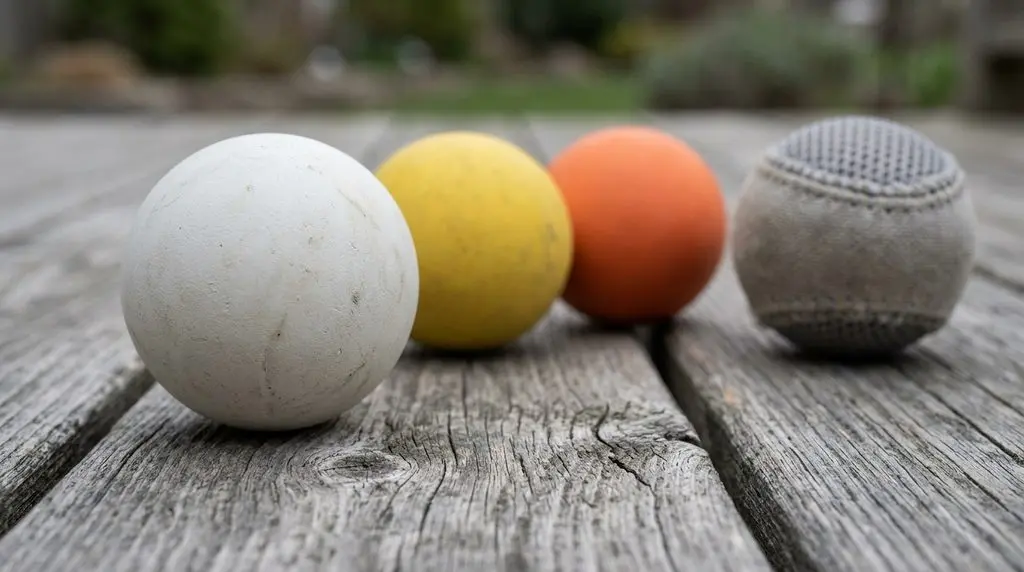
There’s Nothing Inside a Lacrosse Ball, and That’s the Whole Design
Cut one open and you find no core, no winding, no bladder, no seam. What lacrosse balls are made of is a single piece of solid rubber all the way through, which is why they weigh what they weigh and hurt the way they hurt. Almost every other ball in sport is an assembly of parts. This one is a lump.
A lacrosse ball is solid vulcanized rubber, with oils and plasticizers mixed in to keep it soft enough to play. It has no seams, no core and no internal structure. NOCSAE’s ball standard sets weight at 5.0 to 5.25 ounces, circumference at 7.75 to 8.0 inches, and a rebound range, but it specifies performance rather than recipe, so the exact rubber formula is the manufacturer’s.
That last point does more work than it looks like. Because the standard governs how a ball behaves rather than what it’s mixed from, two certified balls from two companies can be chemically quite different and still both be legal. And because the softening agents are mixed into the rubber rather than bonded to it, they can leave. That single fact explains the slick old ball in the bottom of every equipment bag.
What lacrosse balls are made of, in the order it matters
Start with the rubber. Vulcanization is the process that turns raw rubber into something durable and elastic by cross-linking it, and it’s why a lacrosse ball holds its shape under a shot instead of deforming permanently. The ball is cured as one solid piece. There’s no shell and no filling.
Then the softeners. USA Lacrosse’s own explanation is that lacrosse balls have traditionally been made from vulcanized rubber filled with oils and plasticizers to make them soft. Without them you’d have something closer to a hockey puck in sphere form. With them you get a ball that compresses slightly on impact and comes off a stick head predictably.
Here’s the part nobody writes down: those additives are guests, not residents. Over time they migrate out of the rubber and onto the surface. USA Lacrosse describes the plasticizers separating from the rubber and leaching to the surface, which creates the slickness and hardens the ball overall. The greasy ball and the rock-hard ball are the same ball at the same stage of the same process.
No governing body publishes the specific compounds involved. NOCSAE sets what the ball must do, not what it must contain, so anyone listing exact chemicals is guessing. The mechanism is documented. The recipe isn’t.
The numbers the standard actually sets
NOCSAE’s lacrosse ball document is titled, in full, the Standard Performance Specification for Newly Manufactured Lacrosse Balls. The current version is ND049-19m25, modified in December 2025. Those two words in the title, “newly manufactured,” are load-bearing, and we’ll come back to them.
| What’s specified | The requirement |
|---|---|
| Material and surface | Smooth or slightly textured, no seams, solid elastomeric material |
| Weight | 5.0 to 5.25 oz |
| Circumference | 7.75 to 8.0 in |
| Compression-displacement | 130 lbs, plus or minus 20, at 25% displacement |
| Coefficient of restitution | 0.60 to 0.70 |
| Maximum surface texture depth | 0.007 in, or 0.17 mm |
| Test conditioning | At least 24 hours at 72 +/- 4 degrees F, 50 +/- 20% relative humidity |
Two of those deserve a second look.
It’s circumference, not diameter. The standard measures the distance around the ball, 7.75 to 8.0 inches. Plenty of retailer pages quote a diameter figure instead. A diameter can be derived from a circumference, but it isn’t the controlled number, and if you’re checking a ball against the spec you want the one the spec actually uses.
Compression is why it feels like that. The compression-displacement figure describes the load needed to squash the ball by a quarter of its size. Set at 130 pounds give or take 20, it is not a soft object by any reading. People new to the sport consistently underestimate this, and it’s the single best argument for soft training balls indoors and for anyone under about ten.
The texture rule is quietly interesting too. The standard says a ball may be smooth or slightly textured, but it cannot be systematically dimpled or carry raised ridges, and a textured surface can’t exceed 0.17 mm deep. Grip is allowed. Golf-ball dimpling isn’t.
And rebound is a specification, not a side effect. The coefficient of restitution window of 0.60 to 0.70 describes how much energy the ball returns on impact, and because it’s a certified property with a defined range, two certified balls should bounce within shouting distance of each other. That’s the basis for the drop test later in this piece, and it’s why “this one bounces funny” is a more meaningful observation than it sounds.
One more thing the standard quietly tells you: there’s a durability clause. The materials used have to be such that normal wear and tear won’t cost the ball its physical properties as measured in the test method. It’s a sentence worth holding onto, because the whole next section is about what normal wear and tear does anyway.
Why the same material behaves differently after a season
Rubber doesn’t wear out the way netting wears out. A net frays visibly and you can see the hole. A ball changes while looking almost exactly the same, which is the problem.
As the oils and plasticizers leave, two things happen at once, and most players only notice one of them. The surface gets slick, which you feel immediately in your stick. The ball also gets harder overall, which you don’t feel at all until someone takes one off the hand. The slickness is the symptom people complain about. The hardening is the one that matters.
This is also where the certification stamp gets misread. A ball is tested and certified as a new ball, under controlled conditions, before anyone has thrown it. The standard applies, in its own words, to new balls as supplied by manufacturers. Nothing about that certification follows the ball into its third season in a damp garage. If you want the full picture on the stamp itself, what the certification on the side of the ball actually covers is worth ten minutes, and the related question of how to tell when a ball has reached the end follows directly from the material science above.
Storage matters more than most people assume, for the same reason. Heat accelerates the migration. A bag left in a car boot through August is doing something to the rubber that a bin in a cool garage isn’t.
It also explains a complaint coaches hear constantly and usually misdiagnose. When a whole squad suddenly can’t hold the ball in traffic, the instinct is to blame pockets, mesh or stringing. Sometimes it is. But a bin of balls ages as a set, because they were bought as a set and stored together, so the slickness arrives for everyone at once. A stringing problem shows up in one player’s stick. A material problem shows up across the team in the same week.
Colour, incidentally, has nothing to do with any of this. The pigment is mixed into the same rubber and doesn’t change how the ball ages or performs, which is why the rules treat colour purely as a visibility and uniformity question rather than a performance one.
The other kind of ball, and why it’s built completely differently
Soft training balls solve a real problem, and they solve it by abandoning the solid-rubber design entirely.
The Swax Lax® Soft Weighted Lacrosse Training Ball is a sand and rubber mixture inside a soft fabric exterior. Swax Lax are blunt that it isn’t birdseed, which is apparently a rumour they’ve had to fight. At 142 to 149 grams and 64 mm across, it matches a regulation ball on both weight and size, which is the entire point: a player gets honest feedback about what they’re throwing without a solid rubber projectile in a gym.
What it doesn’t match is behaviour. It doesn’t bounce and it doesn’t ricochet, which is exactly why it’s safe on a hardwood floor and why it won’t come back off bleachers at someone’s head. Swax Lax themselves say the balls suit rebounders but don’t work well for wall ball, and that’s not a caveat buried in a footnote, it’s on their own site. A wall needs rebound. A ball engineered not to rebound can’t give you one.
| Standard lacrosse ball | Soft training ball | |
|---|---|---|
| Construction | Solid vulcanized rubber, no seams | Sand and rubber fill, fabric exterior |
| Weight | 5.0 to 5.25 oz per the standard | 142 to 149 g, which lands in the same range |
| Bounce | Rebound is a certified property | Designed not to bounce |
| Indoor hardwood | Not a good idea | Built for it |
| Wall ball | Yes | No, per the manufacturer |
| Certified for games | Yes, when NOCSAE certified | No, it’s a training ball |
The practical read: a soft ball is a legitimate tool for small spaces, young beginners and winter sessions, and it is not a substitute for a game ball. Our longer comparison of the practice-versus-game question goes further into which belongs in which bag.
Does what lacrosse balls are made of change what you buy
Material tells you less about which ball to buy than people expect, because every certified ball is the same material. What varies is whether it’s certified at all, and how old it is by the time it reaches you.
Buy certified, from a seller who can tell you what they’re selling. Our lacrosse balls meet the NOCSAE standard and carry SEI certification, and they come in the colours the rulebooks actually permit, which is its own small minefield covered in the piece on which colours are legal where.
Buy in the quantity you’ll genuinely get through, and store them somewhere cool and dry rather than wherever the bag landed. A Gladiator Lacrosse® Ball Bag in a garage beats a bucket in a car.
And don’t pay a premium for claims about material. There isn’t a secret rubber. There’s a standard, a certification process, and then the clock.
Bottom line
A lacrosse ball is solid vulcanized rubber with softening oils and plasticizers mixed through it, no seams and no core, built to a performance standard that sets weight, circumference, compression and rebound but not formula. Those softeners gradually leave the rubber, which is what makes an old ball slick and hard at the same time. Understand that and you’ve understood almost everything about how lacrosse balls age.
A Word on Gladiator Lacrosse
Gladiator Lacrosse was started by a teenage player who was tired of equipment that didn’t hold up, and the catalogue still reflects that bias toward things built to last. Our lacrosse balls meet the NOCSAE standard and are SEI certified, in singles, packs, boxes and cases depending on whether you’re a parent or a programme. For indoor sessions and younger players we also carry the Swax Lax® Soft Weighted Lacrosse Training Ball, which is a different tool for a different job and we’d rather say so than sell you the wrong one.
You Might Also Like
- What the certification stamp on a lacrosse ball really covers
- Which ball colours are legal at which level
- Training balls and game balls, and what each one is for
FAQ
What is a lacrosse ball made of?
Solid vulcanized rubber, cured as a single piece with no seams, no core and no internal structure. Oils and plasticizers are mixed into the rubber to keep it soft enough to play with.
Are lacrosse balls hollow?
No. A lacrosse ball is solid all the way through. That’s why it weighs between 5.0 and 5.25 ounces at roughly the size of a tennis ball, and why it behaves nothing like one.
Why do old lacrosse balls get slippery?
The oils and plasticizers mixed into the rubber gradually migrate to the surface. USA Lacrosse describes this leaching as the cause of both the slickness and a general hardening of the ball. It happens faster in heat.
What size and weight is a regulation lacrosse ball?
The NOCSAE standard sets weight at 5.0 to 5.25 ounces and circumference at 7.75 to 8.0 inches. Note that it specifies circumference rather than diameter.
Are soft training balls made of the same thing?
No. Soft training balls like Swax Lax use a sand and rubber mixture inside a fabric exterior. They match a regulation ball’s size and weight but deliberately don’t bounce, which is what makes them safe indoors and unsuitable for wall ball.