
Nobody Is Coming to Tell You That Ball Is Finished
Every rulebook in the sport says the ball must meet the NOCSAE standard. Not one of them says how anybody would know whether it still does. That gap is the real reason knowing when to replace lacrosse balls is left entirely to you, and why most programmes get it wrong in the same direction.
Replace a lacrosse ball when the surface has gone slick and glossy, when it no longer grips in the stick head, or when it bounces noticeably differently from a new ball. There is no certified lifespan and no inspection requirement. Certification applies to balls as they leave the factory, so a ball’s compliance is measured once, when it’s new, and never again.
That’s not a loophole somebody forgot to close. It’s how projectile standards work, and once you see it you can’t unsee it in your own ball bin.
Why there’s no expiry date on the side
The NOCSAE document covering lacrosse balls is called the Standard Performance Specification for Newly Manufactured Lacrosse Balls. The title is doing exactly what it looks like it’s doing. The standard states in its scope that it sets requirements for new balls as supplied by manufacturers, and it sets four of them: weight, compression-displacement, circumference and coefficient of restitution. Compression sits at 130 pounds give or take 20 at a quarter displacement, rebound between 0.60 and 0.70.
Every one of those numbers is measured on a ball that has been conditioned for at least 24 hours at a controlled temperature and humidity, and has never been thrown.
Now compare that with helmets. NOCSAE publishes recertification standards for exactly five categories of equipment, and all five are headgear: football helmets and faceguards, ice hockey helmets, baseball and softball helmets, and lacrosse helmets. There’s a whole industry around sending helmets away each off-season to be re-tested and re-stamped. NOCSAE is clear that it recommends rather than requires this, but the pathway exists, and the standard that governs it exists.
No such standard exists for balls. NOCSAE’s lacrosse standards library lists the ball performance specification and the laboratory guide for certifying new balls, and nothing else. There is no recertified-ball standard because there is no recertified ball.
So the obligation in the rulebook is written as though compliance were a permanent property of the object, when it’s a property that was measured on one day under laboratory conditions. Nobody polices the gap because no procedure for policing it has ever been written.
When to replace lacrosse balls, by what you can actually observe
Since no standard will tell you, here’s what’s left: the ball itself, and what the material is doing.
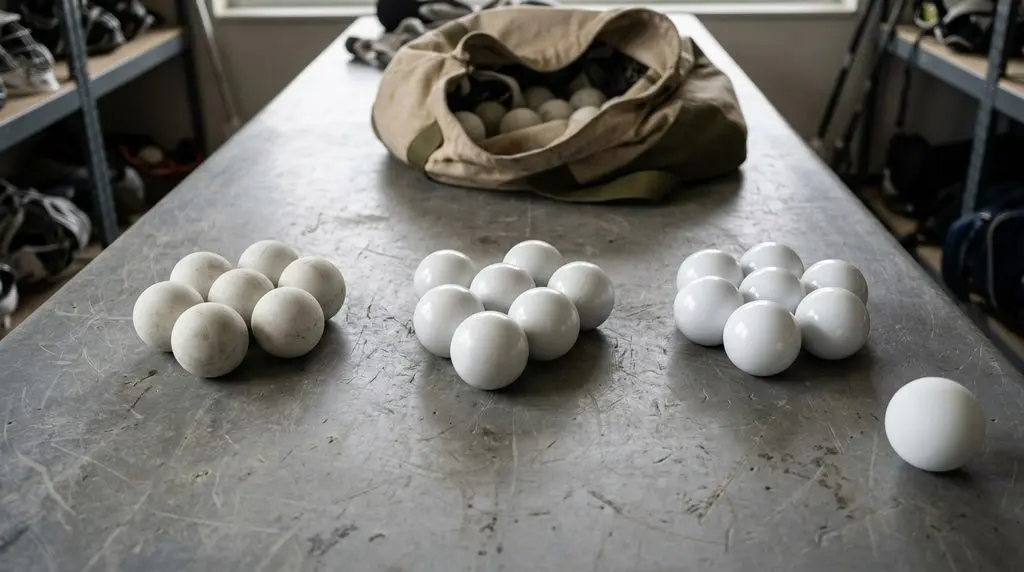
The shine. A new ball has a slightly matte, faintly textured surface. A finished one looks polished. That gloss is the softening agents that were mixed into the rubber arriving at the surface, and it’s the earliest reliable signal.
The grip. This is the one players report first, usually as the ball feeling like it wants to leave the stick on its own. Cradle security drops, catches get loose, and shooters start blaming their pocket.
The hardness. This is the one nobody notices and the one that matters. USA Lacrosse’s explanation is that the same leaching that creates slickness also hardens the ball overall. You are not holding a slippery version of the same ball. You’re holding a harder one.
The bounce. Drop a suspect ball and a new one from the same height onto the same hard surface, side by side. Rebound is a certified property with a defined range, so a clear difference is a real signal rather than a feeling. One company that sells lacrosse balls describes the end state as feeling like a cue ball, which is a useful image as long as you remember who’s saying it.
Do the comparison against a genuinely new ball, not against the next-oldest one in the bin. Programmes drift because every ball in the bucket ages together and the whole set recalibrates your sense of normal.
Can you clean a greaser back to life
Short answer, don’t count on it.
Nobody has published a test either way, which is worth saying plainly rather than pretending otherwise. But reason from the mechanism USA Lacrosse describes and it doesn’t look promising. The slickness is a surface symptom of softeners leaving the rubber. Wiping the surface removes what has already migrated out. It doesn’t put anything back, and it does nothing at all about the hardening, which is the half you can’t feel and the half with safety implications.
Cleaning a ball that’s muddy is maintenance. Cleaning a ball that’s glossy is a delaying tactic.
The one thing worth doing is drying them. A ball that comes off a wet field and goes straight into a sealed bag sits in moisture until someone opens it, and while nobody has published anything on water accelerating the chemistry, mould on a canvas bag is its own reason. Tip them out, let them dry, put them away.
Resurfacing is a different proposition and a more fraught one. Machines to do it exist and have been patented. Whether a resurfaced ball retains any meaningful certification is argued most loudly by companies that sell new balls, which is reason enough not to treat their conclusion as settled. What is not in dispute is that certification describes the ball as manufactured, and a resurfaced ball is not in that condition.
Knowing when to replace lacrosse balls across a whole programme
There’s no governing-body answer to this. I looked, and the absence is real rather than a failure to find it. USA Lacrosse, the NCAA, the NFHS and NOCSAE all require balls to meet the standard and none of them publish a replacement interval.
What’s out there instead is retailer guidance, which you should read knowing that the people writing it sell balls. One retailer suggests programmes replace practice balls every two to four months and game balls every two to three, uncited. That may be reasonable for a heavily used programme and it is certainly convenient for the person selling them.
A more honest framing is that usage and storage drive this far more than the calendar does.
| Situation | What actually drives the timeline |
|---|---|
| Backyard, a few players, bag kept indoors | Years. Inspect annually, replace on feel |
| Club or school programme, daily use | Rotate stock each season, cull on inspection rather than on a date |
| Balls stored in a hot car or shed | Faster than anything else on this list. Heat accelerates the migration |
| Game balls for officiated play | Replace earliest. These are the ones held to the standard in writing |
| Balls used on concrete or asphalt | Surface abrasion is added on top of chemical ageing |
Storage is the variable most within your control and the one most often ignored. Cool, dry and out of the sun beats every cleaning trick. A Gladiator Lacrosse® Ball Bag kept in a garage will do more for a set of balls than anything you do to them afterwards, and for a programme buying in volume the same logic applies to where the case lives between sessions.
There’s also a budgeting argument that programmes consistently get backwards. Balls get treated as a one-off capital purchase, bought in bulk once and then expected to last indefinitely, when they behave much more like a consumable with a long and invisible fuse. A programme that buys a case every other year and culls honestly will spend less over five years than one that buys a huge quantity once, never replaces anything, and ends up running every session with hardware that drifted out of spec somewhere around season three.
The practical structure that works is rotation rather than replacement. New balls go into the game bin. Game balls that are still good but no longer pristine move down to practice. Practice balls that have gone glossy leave entirely. That way the balls held to the written standard are always the newest ones you own, which is the only part of this anyone could ever be called on.
The audit worth doing once a year
Tip the bin out. Take one new ball out of its packaging as your reference.
Sort into three piles: matte and grippy, starting to shine, and polished. The first pile goes back. The third pile goes in the bin, not into the practice bucket, because a ball too hard for a game is not thereby suitable for twelve-year-olds doing ground balls. The middle pile is a judgement call, and if it’s a programme set, err toward replacing, because the one thing you know for certain is that nobody downstream will check.
Then order the replacements in a format that matches how you actually use them. Singles and small packs for a backyard, cases for a programme. Our full lacrosse balls range is NOCSAE compliant and SEI certified, and if you want to understand what that stamp does and doesn’t promise, the certification explainer covers it properly. The parallel logic for the other consumable on your goal is in the repair-or-replace piece on netting, and the underlying material story is in what these things are actually made from.
Bottom line
Replace lacrosse balls on surface condition, grip and rebound, measured against a genuinely new ball rather than against the rest of your bin. Certification is awarded to a new ball under laboratory conditions and there is no recertification pathway for balls the way there is for helmets, so no external check will ever catch a ball that has drifted out of spec. Store them cool and dry, audit once a year, and bin the glossy ones rather than demoting them.
A Word on Gladiator Lacrosse
Gladiator Lacrosse started because a teenage player got tired of equipment that didn’t last, and that’s still the lens. Our lacrosse balls meet the NOCSAE standard and carry SEI certification, and they’re sold in singles, three and six packs, boxes of twelve and cases of 120, so a parent and a programme director can both buy the right quantity rather than the convenient one. For keeping them in usable condition between sessions, the Gladiator Lacrosse® Ball Bag is the unglamorous purchase that does the most work.
You Might Also Like
- What the certification on a lacrosse ball actually promises
- Telling the difference between a net worth fixing and a net worth replacing
- The material these things are made from, and how it ages
FAQ
How often should you replace lacrosse balls?
There’s no governing-body interval. Replace on condition rather than on a date: surface gloss, loss of grip, and a bounce that differs from a new ball. Heat and storage affect the timeline far more than age alone.
Do lacrosse balls expire?
Not formally. NOCSAE certification applies to balls as newly manufactured and there is no recertification standard for balls, so nothing stamps an expiry date or re-tests them later.
Why do lacrosse balls get greasy?
The oils and plasticizers mixed into the rubber migrate to the surface over time. USA Lacrosse describes this as the cause of both the slickness and a hardening of the ball overall.
Can you clean a greasy lacrosse ball?
You can remove the surface residue, but no published test shows cleaning restores a ball. The hardening that comes with the leaching isn’t addressed by cleaning at all, so treat it as a delay rather than a fix.
Is there a rule requiring worn lacrosse balls to be replaced?
No. The NCAA and USA Lacrosse rulebooks require balls to meet the NOCSAE standard but define no inspection or retirement procedure for balls already in use. Pre-game equipment checks cover player gear, not balls.