
Cold Hands, Quick Sticks: A Winter Plan That Shows Up in March
Last verified: October 14, 2026
The first practice of spring always tells you who touched a stick over the winter. It isn’t subtle. Some players catch everything on the first day, and some spend two weeks getting their hands back while the roster quietly fills up. A little winter lacrosse training, done consistently, decides which group you’re in.
When should winter lacrosse training start? Start in November or early December, roughly 12 weeks before your high school season opens. Spring start dates vary by state: Maryland’s 2027 first practice is March 1, Colorado allows first games March 6, and Florida opened its 2026 season with tryouts on January 19. Count back from your state’s date.
Key Dates for Your Winter Calendar
| Event | Dates | Location / format | Source |
|---|---|---|---|
| NLL (pro box lacrosse) season opens | Saturday, Nov. 28, 2026 | Indoor arenas, US and Canada | Toronto Rock’s 2026-27 NLL schedule announcement |
| Florida high school lacrosse: first practice/tryout date | Jan. 19, 2026 was last season’s date. 2027 date not confirmed as of Oct. 14, 2026 | Florida (FHSAA) | FHSAA’s 2026 lacrosse season dates |
| Maryland boys lacrosse: first practice | March 1, 2027 (first play March 22) | Maryland public schools (MPSSAA) | MPSSAA’s 2027 boys lacrosse calendar |
| Colorado boys and girls lacrosse: first scrimmages and games | March 6, 2027 | Colorado (CHSAA) | CHSAA’s 2026-27 lacrosse start-date adjustment |
These are examples, not a national calendar. High school lacrosse dates are set state by state, and in some states lacrosse runs as a club sport rather than a sanctioned school sport. Check with your school’s athletic office or your state association for your own date.
Why Winter Lacrosse Training Matters More Than Fall
Fall ball is fun, and it’s often where college coaches are watching. Winter is quieter, and that’s exactly why it pays off. No games, no tournament schedules, no travel. Just you, a wall and whatever you decide to work on.
Stick skills fade quickly when they aren’t used. A player who takes December and January off usually spends the first weeks of spring rebuilding feel for the stick, while players who kept up even modest winter lacrosse training show up already sharp. Coaches making early roster decisions notice the difference on day one, not day twenty.
Winter is also the best time to fix one real weakness. A weak hand, a slow release, shots that drift high. You won’t fix it in a week of preseason. You can fix it in ten weeks of short, focused sessions.
What Changes for 2027
One rules note for boys’ players. In August 2026, the NFHS began permitting states to use a shot clock in high school boys’ lacrosse, according to an MPSSAA announcement of the 2027 rule changes. Each state decides whether to adopt it, so ask your coach. If your state does, possessions get shorter and quick, decisive shooting gets more valuable, which is one more reason to put catch-and-shoot reps into your winter lacrosse training.
Winter Lacrosse Training Without a Field
Frozen fields and early sunsets are the real obstacles, so plan around them.
- Wall ball works anywhere with a solid wall. A brick wall, a basement foundation or a garage wall (with permission) is enough. Our wall ball routine with rep counts gives you a structure so you aren’t just throwing the ball around.
- Shooting needs a goal and some daylight. Weekends and the occasional mild afternoon are your shooting days. Keep the goal set up and ready rather than packed away, so a 30-minute window doesn’t turn into 20 minutes of assembly.
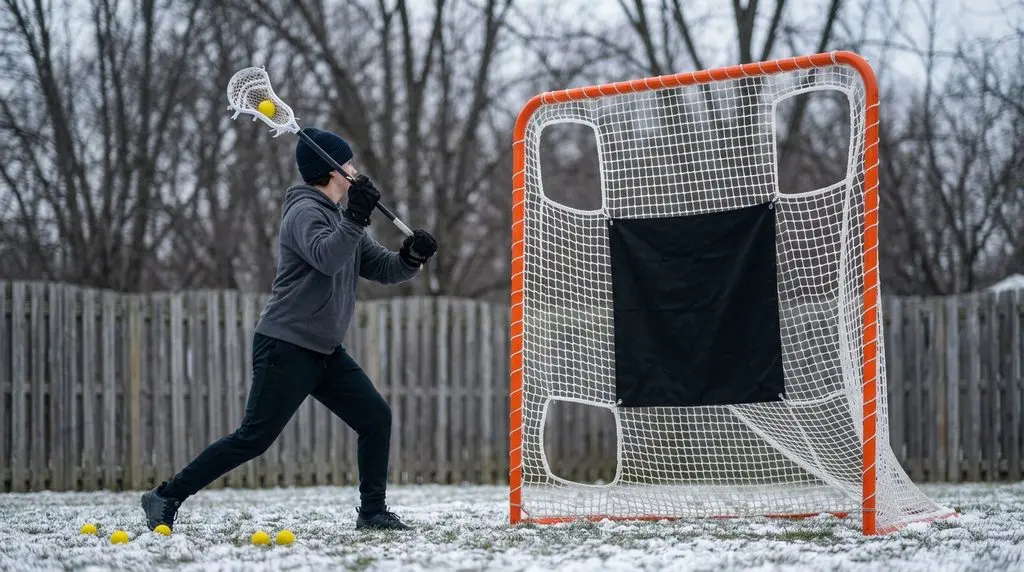
- Bright balls in snow. Yellow and orange balls are much easier to find in snow and frost than white ones. Keep a few extra so a lost ball doesn’t end the session.
- Look after the goal. A backyard goal that stays out all winter needs a little care. Our goal maintenance and off-season storage guide covers what to check and when to bring the net in.
How to Get Ready: A 12-Week Winter Lacrosse Training Calendar
Work backward from your first practice or tryout date. If your state opens in March, start in early December. If it opens in late January, start in November.
12 to 8 weeks out: build the habit. Aim for short daily sessions rather than long weekly ones. Wall ball most days, both hands, with the weak hand getting at least half the reps. Pick the one weakness you want gone by spring and write it down. On shooting days, focus on form and accuracy over power. An open net rewards lazy aim, so a target that blocks the middle of the goal is a big help here. The Gladiator Lacrosse® Beginner Goal Target covers the centre of a 6×6 goal and leaves the corners open, so every shot has to go where goalies don’t want it.
8 to 4 weeks out: add speed. Shorten your wall ball sets and speed them up: quick sticks, catch-and-release, switching hands on every rep. On shooting days, move before you shoot. Catch, take two steps, release. If you’re a girls’ player, practice with the ball colours your games use, and if you’re a boys’ player in a state adopting the shot clock, practice shooting off the catch without extra cradles. Make sure you have enough balls that you aren’t spending the session chasing them; a Gladiator Lacrosse® Pack of 6 Official Lacrosse Balls (Yellow) is plenty for a backyard session and easy to spot on frosty grass.
The final 4 weeks: game shape. Now it’s about looking ready on day one. Keep wall ball daily, but treat it as maintenance. Shoot from the spots your position actually shoots from. Check your gear: stick pocket, strings, helmet or eyewear fit, gloves. Ask your coach what the first week will look like so nothing surprises you.
Tryout week. Don’t cram. Keep wall ball light, sleep well, and show up with a stick you trust. Ten weeks of work is already in your hands.
The Bottom Line
Winter lacrosse training doesn’t need a field, a club team or a big budget. It needs a wall, a few balls, a goal you can shoot on when the weather allows, and a plan that counts back from your spring start date. Start now and the first practice in March feels like practice number forty.
A Word on Gladiator Lacrosse
Gladiator Lacrosse was started in 2012 by Rachel Zietz, a 13-year-old player in Boca Raton whose coaches kept telling her the same thing: play wall ball as much as you can. The backyard gear she could find was either too expensive or didn’t survive outdoors, so she built her own company to fix it. The lineup is still lacrosse-only. For winter shooting days, the Gladiator Lacrosse® Beginner Goal Target turns any 6×6 backyard goal into an accuracy drill, and the full range of targets steps up from there.
You Might Also Like
- A wall ball routine with rep counts for every level
- How to look after and store a backyard lacrosse goal
- Shop lacrosse shooting targets
Frequently Asked Questions
When should I start winter lacrosse training?
Start roughly 12 weeks before your spring season opens, usually November or early December. Dates vary by state: Maryland’s 2027 first practice is March 1, Colorado’s first games are March 6, 2027, and Florida’s 2026 season opened with tryouts on January 19.
How can I train for lacrosse in winter without a field?
Use a solid wall for daily wall ball, keep a backyard goal set up for shooting on mild days and weekends, and use bright yellow or orange balls so they’re easy to find in snow and frost.
How often should I practice lacrosse in the off-season?
Short, frequent sessions work better than long, occasional ones. Daily wall ball of around 15 to 30 minutes, plus shooting a few times a week when weather allows, keeps your hands sharp for spring.
When do high school lacrosse seasons start?
It depends on the state. In 2027 Maryland’s first practice is March 1 and Colorado’s first games are March 6, while Florida’s 2026 season opened January 19. Some states run lacrosse as a club sport, so check with your school or state association.
Is there a shot clock in high school boys’ lacrosse now?
In August 2026 the NFHS began permitting states to use a shot clock in boys’ lacrosse for 2027. Each state association decides whether to adopt it, so ask your coach or check your state association.