
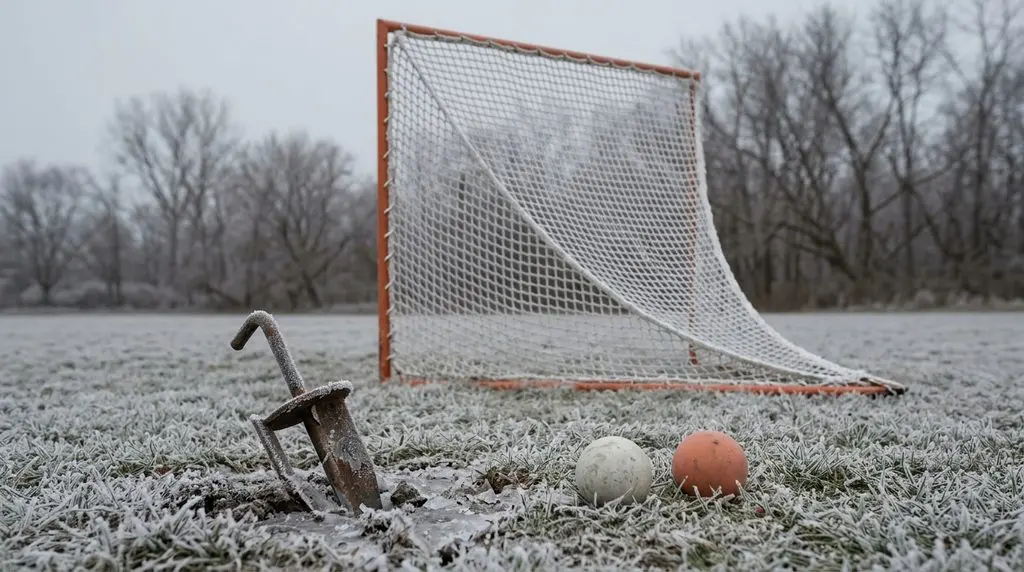
Your Ball Is Certified for 72 Degrees and Nothing Else
Here’s a detail that doesn’t appear on any packaging. Before a lacrosse ball is tested for certification, it sits for at least 24 hours at 72 degrees Fahrenheit, give or take four, at controlled humidity. Every number it earns is earned in those conditions. Which means that playing lacrosse in cold weather puts your equipment somewhere the standard simply doesn’t go.
Cold makes rubber stiffer and less resilient, so a lacrosse ball in freezing conditions behaves differently from the certified one in the lab. How much differently, nobody has published. NOCSAE’s standard specifies a room-temperature conditioning period before testing and sets no cold-weather requirement at all, so a certified ball’s behaviour below freezing is outside the scope of its certification rather than covered by it.
That’s not a scandal. It’s just a boundary, and almost nobody playing in February knows where it is.
What the standard actually covers, and where it stops
The NOCSAE lacrosse ball specification sets four performance figures: weight, circumference, compression and coefficient of restitution, which is the rebound measure. The rebound window is 0.60 to 0.70.
All four are measured after the conditioning period described above. There is no second test at 30 degrees. There is no cold-weather clause. The standard is a manufacturing specification tested under controlled laboratory conditions, and it never claims to be anything else.
So when someone tells you a certified ball is a certified ball regardless of conditions, they’re half right. It was certified. The certification describes how it performed at room temperature on a bench.
What actually happens to lacrosse in cold weather
Let’s separate what’s established from what’s guesswork, because the internet does not.
Established, in general materials science: polymers stiffen as temperature drops. Elastomers move from rubbery behaviour toward glassy behaviour, losing elasticity and the ability to recover deformation. Impact resistance falls. This is well documented across the materials literature and it is not controversial.
Not established, anywhere: how a lacrosse ball specifically behaves at any specific temperature. There is no published test. Not from NOCSAE, not from a manufacturer, not from a university. The temperature figures floating around the internet come from studies of entirely different rubber compounds, usually industrial seals, and transferring them to a lacrosse ball would be making something up with extra steps.
So the honest version is: colder means stiffer and less lively, direction confirmed, magnitude unknown.
If you want to see it for yourself, the comparison is easy and more informative than anything you’ll read. Leave one ball indoors overnight and one in an unheated shed, then drop both from the same height onto the same hard surface in the morning. You’re not measuring anything to a standard, but you’ll see whether there’s a difference worth caring about in your conditions, which is more than any published source can currently tell you.
What you can act on is the overlap with ageing. A ball that has already lost softening agents to the surface is already harder than it was new. Cold adds to that, which is why the brick-like ball in January is usually one that was already on its way out in September. Winter doesn’t ruin good balls so much as expose finished ones. Working out which of yours are finished is a better use of an afternoon than worrying about the thermometer.
The practical move for genuinely cold sessions is to stop using a hard rubber ball where you don’t need one. A Swax Lax® Soft Weighted Lacrosse Training Ball matches regulation size and weight without the solid rubber, which makes a half-frozen hand a much smaller problem. It won’t do wall ball, by the manufacturer’s own admission, but for passing and catching in the cold it’s the sensible swap.
Nets, frames and the frozen ground problem
Netting. I’ll be straight: the claim that freezing damages lacrosse netting is repeated constantly and sourced nowhere. Netting manufacturers’ own material guides discuss UV degradation and water absorption at length and don’t address cold at all. Nylon absorbing water while polyester largely doesn’t is a real and widely stated difference, but nobody has published anything connecting that to freeze damage in a lacrosse net. Treat confident claims in either direction with suspicion.
What is well established is that UV and constant weather exposure shorten a net’s life, which is the actual argument for taking it off over winter rather than anything to do with ice. The off-season storage routine covers that properly, and the short version is that the net is the half worth carrying indoors.
Anchoring on frozen ground. This is where the standards picture gets genuinely bleak, and it’s worth knowing.
The CPSC’s movable goal safety guidance, the document everyone cites, is from 1995 and covers soccer goals. The word “lacrosse” does not appear in it. Neither does the word “frozen.” Its only guidance for ground that can’t be penetrated by a conventional anchor is sandbags, and the example it gives is an indoor practice facility.
The ASTM picture has got worse rather than better. The tip-resistance standard was withdrawn in 2017. The soccer goal specification was withdrawn in 2018. And the guide that actually covered installation, use and storage of movable goals was withdrawn in 2025. The one active standard covers soccer goals over forty pounds and says nothing about anchoring. A replacement for lighter goals is still only a work item.
| What people assume governs this | Actual status |
|---|---|
| CPSC movable goal guidance | 1995, soccer only, silent on lacrosse and on frozen ground |
| ASTM F2673, tip resistance | Withdrawn 2017 |
| ASTM F2056, soccer goal spec | Withdrawn 2018 |
| ASTM F1938, installation and use guide | Withdrawn 2025 |
| ASTM F2950, current spec | Active, soccer goals over 40 lb, no anchoring content |
So there is no standard, from any body, governing how you anchor a lacrosse goal on frozen ground. Which means the practical advice has to come from physics rather than from a document: stakes driven into frozen soil give less than they appear to, they lift when a thaw loosens the ground, and a goal that was properly staked in October may not be properly staked in January. Check it rather than assuming. If the ground won’t take an anchor at all, weight the frame and move it off anything sloped or near a road. Bungee fasteners keep the net to the frame but they do nothing about the frame to the ground, and those are separate jobs.
When lacrosse in cold weather stops being worth it
No national governing body publishes a cold-weather policy. The NFHS maintains position statements on heat acclimatization and on lightning, and has none on cold. USA Lacrosse and the NCAA publish no national threshold either. Every temperature cutoff you’ve seen belongs to a state association, a conference or a club, and they disagree with each other.
That doesn’t mean cold is never a reason to stop. A Division I men’s game was called off for dangerous temperatures in January 2026, so the judgement does get made at the top of the sport. It means the judgement is local and nobody has handed you a number.
For equipment specifically, the cutoff worth respecting is simpler than a thermometer reading. If hands are too cold to catch reliably, a hard rubber ball travelling at speed is a different proposition than it was in October, and the sensible answer is a softer ball, a gym, or a shorter session. Training balls and game balls do different jobs, and winter is when that distinction pays.
The structural point behind all of it: catching is the skill that degrades first in the cold, and it degrades in the player rather than in the equipment. Cold fingers grip differently, reaction time drops, and the margin for a missed catch narrows at exactly the moment the ball has got harder. That combination is why winter sessions are better built around volume at lower intensity than around full-speed work, and why a soft ball changes the risk arithmetic more than any other single decision available to you.
A short, deliberate session with the right ball beats a long one spent waiting for feeling to return to somebody’s hands.
Bottom line
Lacrosse balls are certified at room temperature and nowhere else, so cold-weather behaviour is outside what the stamp covers. Rubber stiffens in the cold, the direction is certain and the magnitude is unpublished, and the balls that go brick-hard in winter are usually ones already degraded by age. Nobody has sourced a claim that freezing damages netting. There is no current standard anywhere governing goal anchoring on frozen ground, so check your anchors after a freeze and a thaw instead of trusting October’s work. Switch to a soft training ball when hands stop working properly.
A Word on Gladiator Lacrosse
Gladiator Lacrosse was started by a teenage player who wanted equipment that survived more than one season, and winter is where that gets tested. Our lacrosse balls are NOCSAE compliant and SEI certified, our replacement nets come in thicknesses built for goals that live outdoors all year, and for genuinely cold sessions we carry the Swax Lax® Soft Weighted Lacrosse Training Ball, which keeps players throwing when a hard ball stops being sensible. We don’t sell gloves or base layers, so we’ll leave that part to someone who does.
You Might Also Like
- Getting a goal and net through the off-season intact
- How to tell when a ball has reached the end of its life
- Which ball belongs in which session
FAQ
Do lacrosse balls get harder in cold weather?
Rubber stiffens as temperature falls, so yes in direction. No lacrosse-specific test data has been published, so anyone quoting a precise figure is extrapolating from other materials. Certification testing happens at around 72 degrees Fahrenheit, not in the cold.
Is it safe to play lacrosse in freezing temperatures?
No national governing body publishes a temperature threshold. State associations, conferences and clubs set their own and they differ. For equipment specifically, the practical limit is when hands can no longer catch reliably, at which point a soft training ball is the sensible swap.
Does cold weather damage lacrosse nets?
No source could be found supporting this, in either direction. Netting manufacturers’ own material guides address UV and water absorption but not cold. UV exposure over a full year is the better documented reason to take a net off in the off-season.
How do you anchor a lacrosse goal on frozen ground?
There’s no current standard covering it. The relevant ASTM standards were withdrawn in 2017, 2018 and 2025, and CPSC guidance covers soccer goals and never mentions frozen ground. Practically: stakes hold poorly in frozen soil and loosen on a thaw, so re-check anchors rather than assuming autumn’s setup still holds.
Should you use a different ball in winter?
For training in the cold, a soft weighted training ball matching regulation size and weight is easier on cold hands than solid rubber. It won’t work for wall ball, per the manufacturer, but it’s well suited to passing, catching and rebounder work.